Author Archives: thinkofitasanadventure

Unknown's avatar

About thinkofitasanadventure

My husband Peter and I attended a sustainability conference with Richard Heinberg of the Post Carbon Institute in 2010. We learned some hard truths about climate change that shook us to our core. We knew we needed to transition away from fossil fuels as soon as possible, for the sake of our children. We initiated a neighborhood Transition group (Transition Longfellow). It became the center of our lives. In 2019, we downsized and moved to a tiny rural village. It's a whole new way of life and we've got a lot more learning to do. We're choosing to continue to "think of it as an adventure."

Visit a Community Garden This Saturday

Healthy food means healthy people – support your local gardener!

This Saturday, August 11, 2012, is Community Garden Day. Sixty (60) community gardens will host events that are free and open to the public. Event times and activities vary from garden to garden, and include art projects, kids’ activities, garden tours, potlucks, musical acts, presentations on horticultural topics, and more. You can find a complete listing of participating gardens, event times and activities at Gardening Matters.

Community Garden Day is organized by Gardening Matters, a nonprofit that helps grow successful and sustainable community gardens by supporting the gardeners that make them happen.

The benefits of community gardens are many. The cities of St. Paul and Minneapolis have passed resolutions recognizing the contributions of community gardens and gardeners to the quality of life in the Twin Cities. Bloomington and Edina passed proclamations acknowledging the role of community gardens in creating more active and healthy residents.

But improved health may be only part of the story – reduced crime may be another. A recent article in Mother Jones looks at research on urban farming and its impact on employment and crime. The Urban Farm Guys — my heroes — are also working on dropping crime rates.

Community gardens are an important part of the food justice movement and yet there isn’t enough space for everyone who would like to garden. In some communities, there is a waiting list. I’m thrilled that Gardening Matters exists and I’d like to see more community spaces turned over to people who want to grow food. Church lands are often ideal.

I’d also like to encourage people who want to garden to ask neighbors with a sunny lawn if they could use some of their space to create a shared garden. You never know who might say yes. This week we held National Night Out at our house. As I was going door-to-door, one of my neighbors complained about her apple tree. She doesn’t collect the apples. They are a “problem” for her. I told her we would be happy to harvest them. Come September, we will make apple sauce and hard cider.

The Three Actions Project Begins

In an effort to jump-start our 2012 challenge goal of becoming a zero-waste household, we’ve become part of the Three Actions project. The three ACTIONS Project is a community-action program designed to “support individuals in developing sustainable lifestyle habits and to capture individual experiences to inform greater change in community services, design, and public policy.”

We heard about the program through the Alliance for Sustainability. We checked out the website, and especially the menu of actions, and we liked the structured approach. If you click on each action, it provides information and a series of worksheets to help you develop a baseline and track your progress.

Together we’ve chosen to:

  • Eliminate all waste (our original goal for 2012)
  • Reduce our plug usage by 33%

Leslie has also chosen to eliminate food spoilage and waste (think garden produce) and Peter has chosen to live within his water budget.

We haven’t finished week 1 (baseline measurements) but so far we’re having a bit of trouble getting our heads around measuring. Waste and food waste haven’t been hard, but understanding how much rainwater falls on our house (natural water budget) was difficult. And we haven’t finished filling out the forms to understand electrical usage for each appliance. But we’re plugging away.

Let’s see what we can do in the next 60 days.

Transition Speaker Brian Kaller Coming to Twin Cities in July

In 2010, my husband and I changed our lives because we heard Richard Heinberg speak about the Transition movement. This may be your chance to have a life-changing encounter with the message of the Transition movement.

Brian Kaller, a former Twin Citian now living and working in Ireland, will be speaking at Macalester College in a FREE talk entitled, “O’Sterity: How the Irish Thrived in Desperate Times.”

In the coming decades, we will all face the inter-related challenges of peak oil, climate change and economic instability (what the Transition movement calls “the Long Emergency.”) Among the tools we have for meeting these challenges are the skills and knowledge gathered by traditional cultures over the centuries — skills and knowledge that allowed humankind to thrive. Ireland in the 1970s, when his wife was growing up, was a country “poorer than many Third-World countries, and not everyone had electricity or indoor plumbing.” Despite hardships, statistics show that people at that time were better-educated and healthier. And in surveys, the Irish reported being happier at that time than Americans report being today. Brian will talk about ways people can thrive during chaotic times, giving examples from Ireland.

You can learn more about Brian Kaller by visiting his blog, “Restoring Mayberry.”

WHEN (note, this is the same presentation, given on two different days):
Friday, July 13: 6:00 – 6:30 pm reception; 6:30 program
Saturday, July 14: 7:00 pm program

WHERE: Weyerhaeuser Hall, Macalester College, on the corner of Macalester Street and Grand Avenue, St. Paul, Minnesota.

Irrigation-Free Landscaping Workshop

Some of the effects of global climate instability are increasingly violent storm activity as well as high temps and droughts. Many north Longfellow homes are already challenged by occasional basement flooding during heavy storms and it’s not uncommon for water to collect in the street when the sewer system becomes overburdened from heavy rains. Landscaping can help both of these problems – providing a way for rainwater to stay on the homeowners property and out of the sewer, and minimizing the impact of drought and water needed to maintain plants in the yard.

On Saturday, July 28th, from 11:00 am to noon, the landscape design firm PRAIRIEFORM will lead a workshop on irrigation-free landscaping for residents of the Longfellow neighborhood. Irrigation-free landscaping combines drought-tolerant planting techniques and “drought training” for plants. It creates a landscape that does not require supplemental watering and that minimize rainwater runoff from a property while still providing an animal- and people-friendly yard. The irrigation-free landscape is formal enough to fit in a front-yard setting.

The workshop will be held in a yard on the northeast corner of 28th Street & 42nd Avenue. This is the location of the irrigation-free landscaping pilot project the neighborhood undertook last year, with funding from the homeowner, the Mississippi Watershed Management Organization and LCC’s Environment & Transportation Committee.

If you’d like to attend, please RSVP (appreciated but not required) to Spencer: spencer@longfellow.org or call 612-722-4529 ext. 5.

Garden Update – June in Minnesota

Back in January, I signed up for the Permaculture Research Institute’s Urban Farming program. I’ve been attending classes, meeting people, getting excited about all I could do and — new for me — putting limits on what I am going to do.

  • This year I’m saying “yes” to enlarging the vegetable garden, adding more fruits and berries, making the public space (boulevards) more attractive, and building a better looking and more functional infrastructure (fences, gates, paths, boxes, trellises, teepees, cold frames, a hoop house for fall). All this work should take us through the end of the year.
  • If conditions are good for it (meaning, I’ve let plants go too long), I’m going to try seed saving. I took an intro to seed saving class last Saturday and am now convinced of the critical importance of learning this skill.
  • This year I’m saying “no” to urban chickens and mushroom logs. I need to focus on doing veggies and fruit better before I move on to other things.
  • For the foreseeable future, I’m saying no to fish farming, aquaponics and bees.
  • Gardening as Community Building

    I’m out in the yard several days a week. In addition to the unexpected tan, one of the pleasant side effects of all this hard work has been meeting neighbors. People like to talk about gardens, and as they do, they often ask about the solar panels and other things we’re doing here. I’ve had many chances to talk about the transition away from fossil fuels. Of course, I also love all the compliments we get on our garden. It’s encouraging to know that people appreciate what we’re trying to do.

    Because of our focus on the home tour and the need to build fences, we got a late start with planting. Our indoor seedlings were a bust so we had to buy plants or reseed outdoors. Here’s how our garden is shaping up.
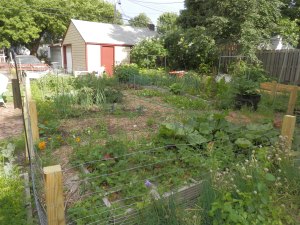
    This is the primary backyard garden. I have 2 dozen tomato plants, as well as onions, chives, leeks, kale, beets, lettuces, radish, carrot, peppers, bok choi, potatoes, fennel, nasturiums, marigolds, rosemary, oregano, dill, basil, garlic, rhubarb, strawberries, brocolli, brussels sprouts and cabbage.
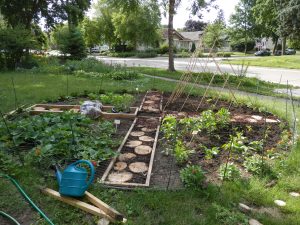
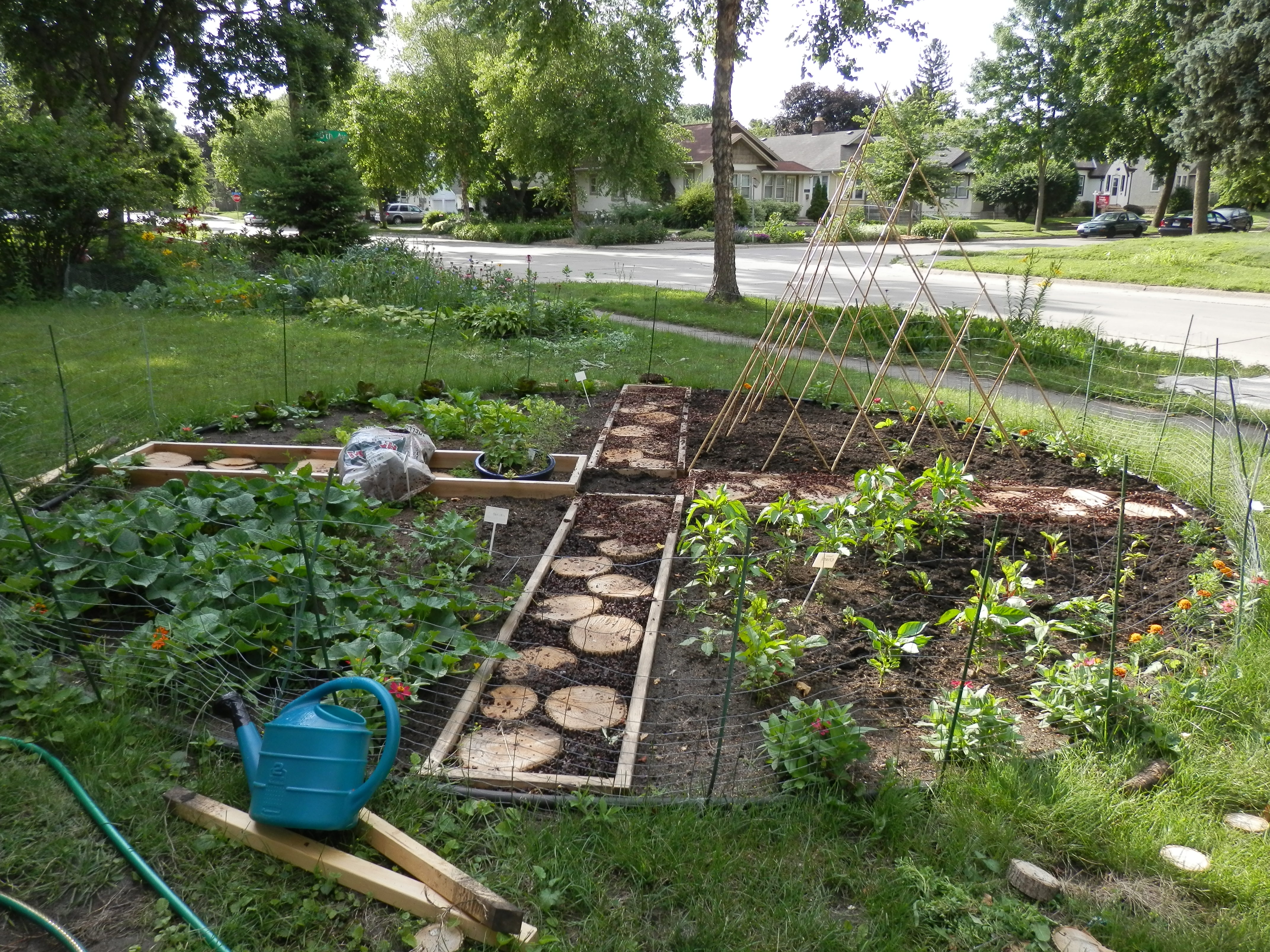
    The new round garden has a border of zinnias. One section holds cucumbers and kale. Another section holds peppers and swiss chard. One section has peppers and lettuces. One section has soil problems. I’ve added the teepee and am going to put beans there to improve the soil. I’ve purchased a bean innoculant for nitrogen fixing. The pathway is made of sections of the tree that was cut down from this spot in order to install the solar panels. We’ve used the cocoa bean husks around and under the wood sections to help hold them in place.
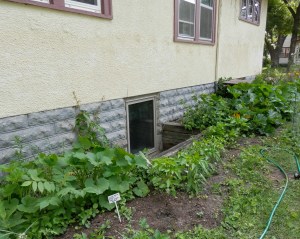
    We pulled all the flowers and weeds from here and planted squash, zucchini, peppers, blueberries and grape vines. We’ve got zucchinis all ready to pick!

    We’ve converted part of the front flower bed to collards, chard and zucchini. There has been some pest damage and they may not be getting as much sun as they’d like, but everything is growing. So far, so good.
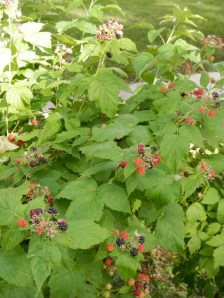
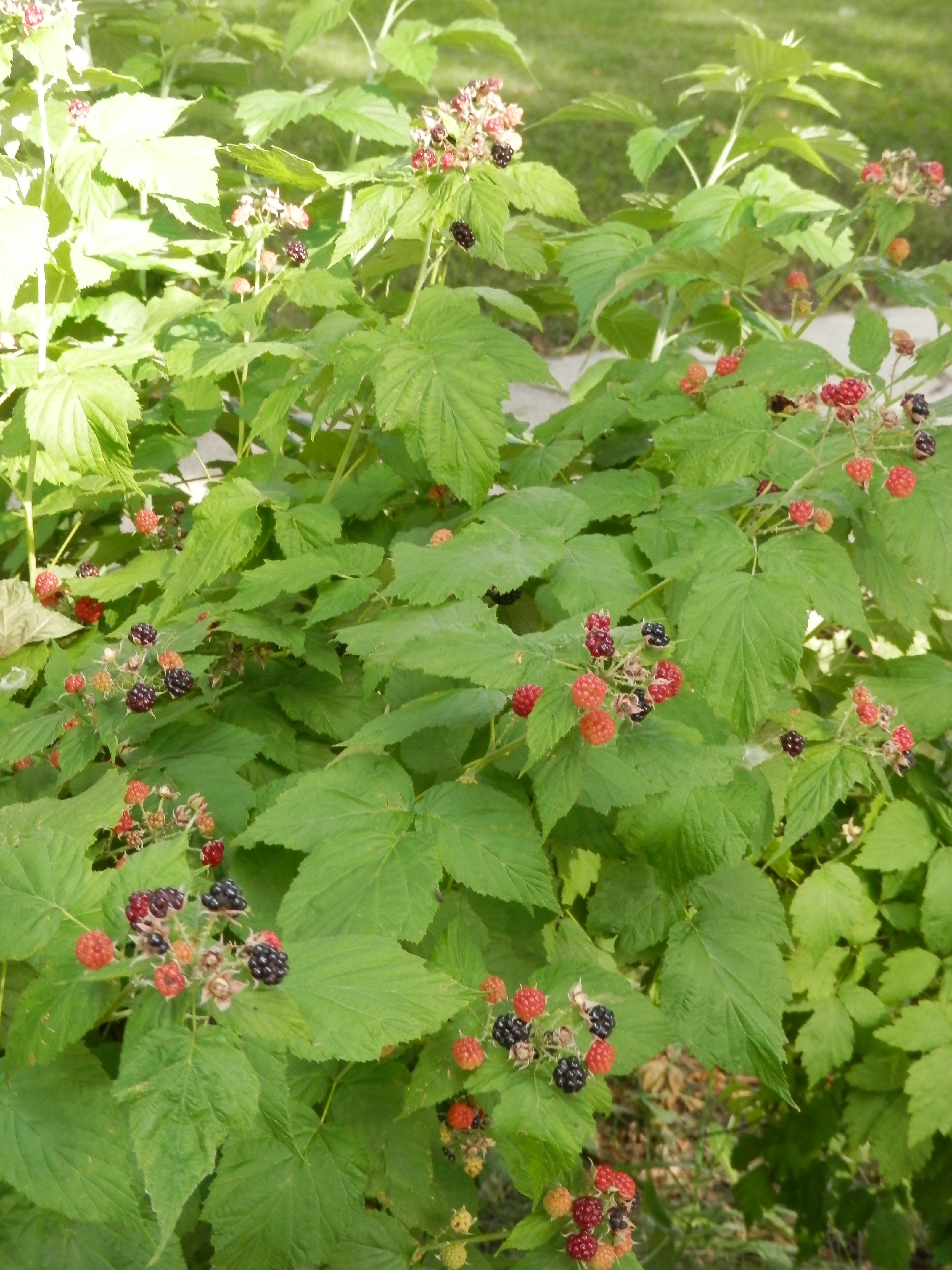
    This is a black raspberry bush that planted itself. I love the multicolored berries. We had to move our regular raspberry bushes last year to paint the garage. Two of them died, but the others are hanging in there and producing lots of fruit despite their small size. We’ve got a few blueberries on the brand new blueberry bushes and for the first time, we’re seeing a few berries on the currant bushes.

    All the plants that were removed from the side of the house were moved into a flower garden by the sidewalk. With extra shade from the boulevard trees, they are thriving.

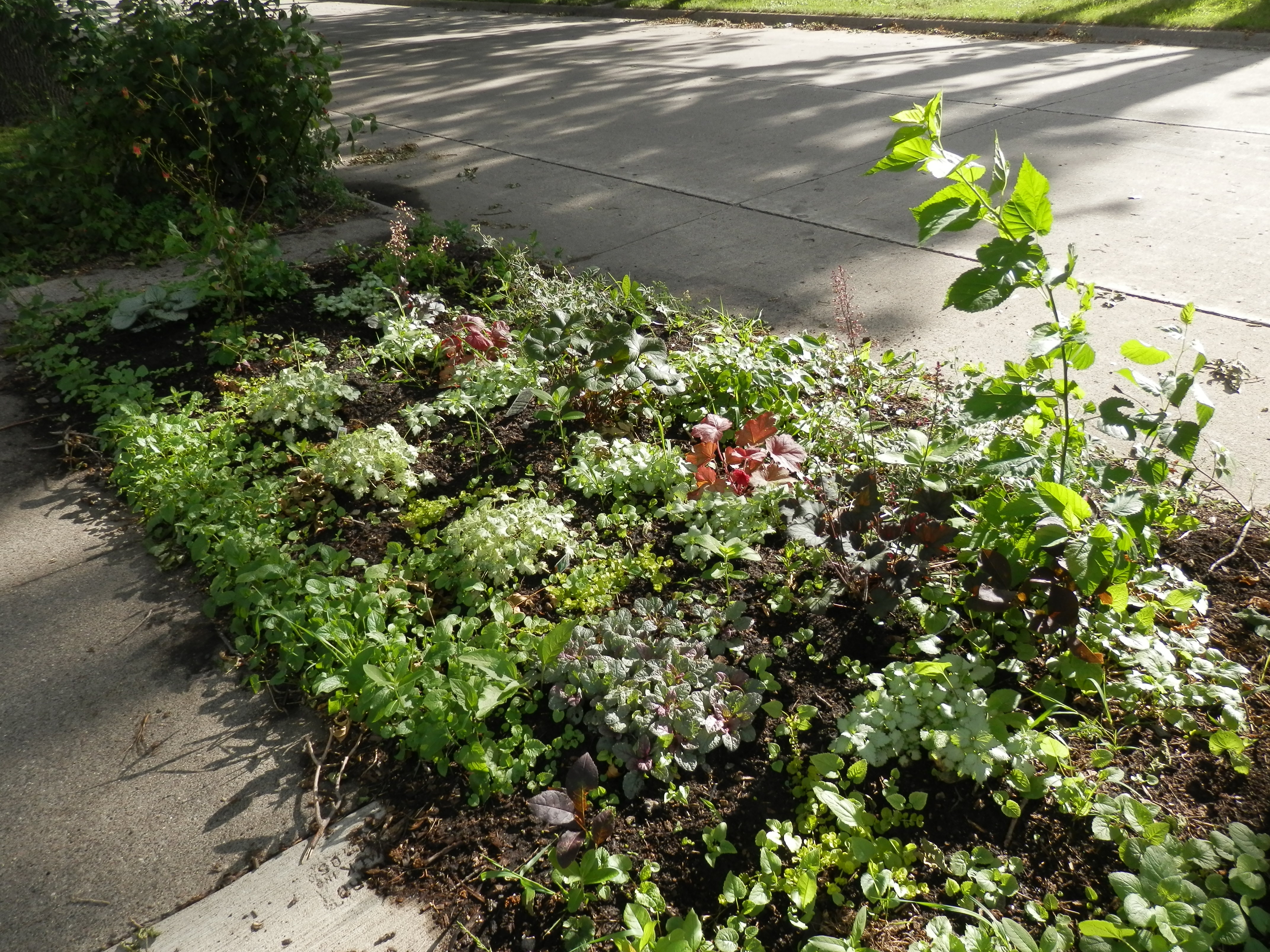
    This has long been a problem area – the front boulevard that is heavily shaded for most of the day. We’re starting over with a variety of silvers, reds and yellow-greens. It’s been 3 weeks and everything is still going strong.

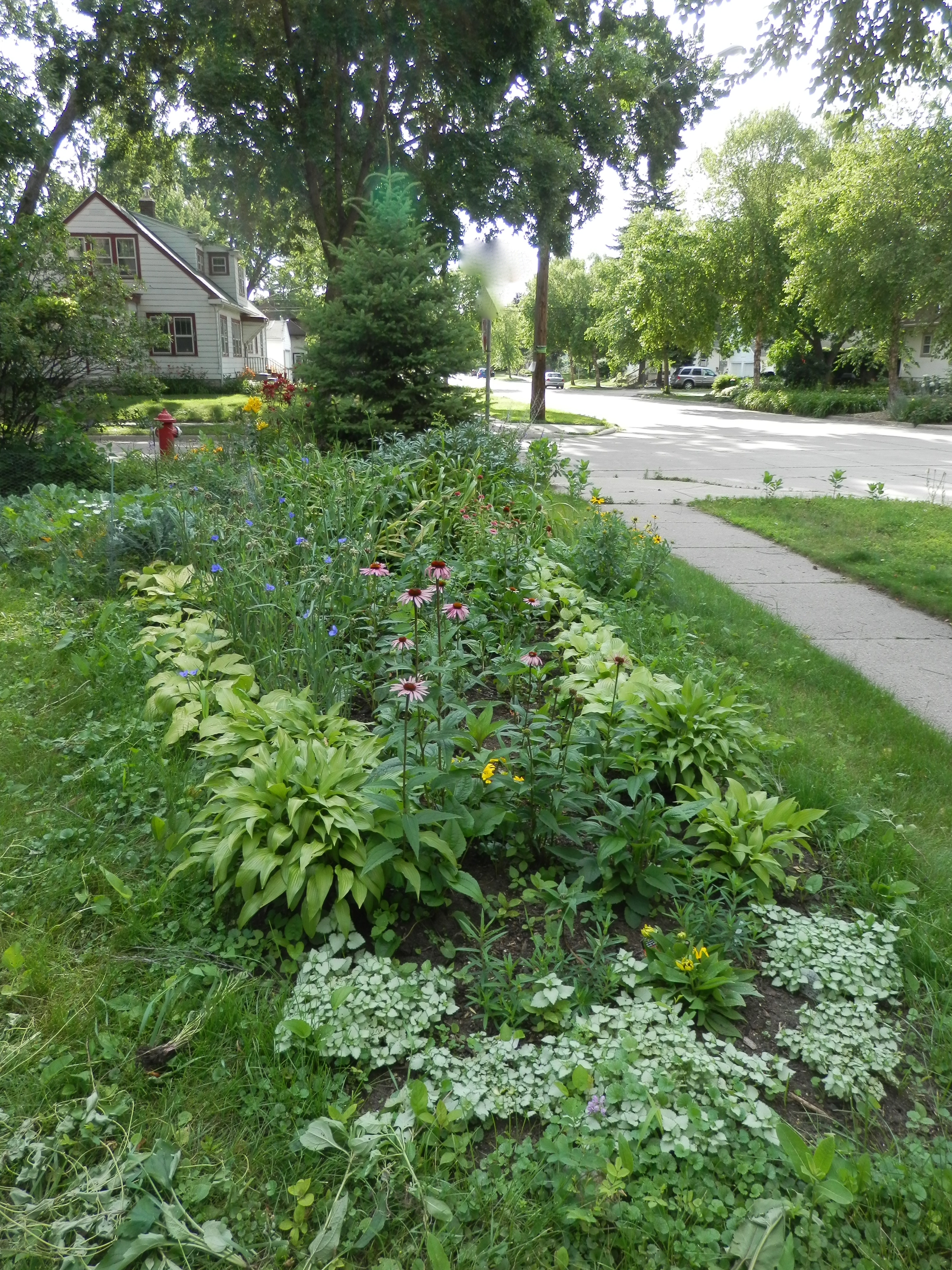
    We’ve been working on this area for quite a few years. The soil was very bad, but bulbs do well here, as does the oh-so-fragrant milkweed. I added more penstemon and a couple of lavender plants, yarrow and some small silver plants.

    I don’t have photos of the work in the rain garden, which is ongoing. We added an elderberry bush, 5 ground cherries and two more horseradish plants. We’ve built three raised beds but they aren’t filled yet. There’s lots to do in this area.

    Garage Cleaning with Reduce/Reuse/Recycle in Mind: Part 1

    Our household, like so many American households, has too much stuff. Despite getting rid of 1,079 things when we took the “1,000 things” challenge two years ago, we still had so much stuff that I sometimes wound up buying things I knew I already owned simply because I couldn’t find them. My house didn’t look cluttered, but hidden from public view in the storeroom, laundry room, office and garage was a tidal wave of stuff that I’ve been working to remove for the past two months. Finally, this week, I was ready to approach the space I dreaded most — the garage.

    I dreaded it not only because of the amount of work, but also because I knew this cleaning project would require a trip to the landfill and I HATE to contribute to the waste stream. Here’s how we went from “I can’t move” to “Wow, I could put a car in here” while working to reduce the number of things that became waste.
    Continue reading

    We’re on the Mpls/St Paul Home Tour

    Oops! I should have posted this on Friday but it’s not too late. Our house is on the Minneapolis/St. Paul Home Tour. The Tour continues on Sunday, April 289 from noon to 5 pm. A representative from Innovative Power Systems, our solar installer, will be on hand from approximately noon to 2 pm. The builder who did our second floor addition will also be here for part of the day.

    We are house #31. Stop in and see our solar PV and heat systems. I’ll be happy to answer any questions. And my husband is stationed in the basement by the worm bin where he can talk about vermiculture, composting and home brewing. Our greeter, Annette, is knowledgeable about recycling and waste management so feel free to talk to her about where the City of Minneapolis is going with its new recycling programs.

    Hope to see you on Sunday!

    Intro to Solar Cookers

    Every year my husband’s family took a trip to Arizona to visit his grandmother. He has vivid memories of eating hot grapefruit and soggy crackers that were left in the back window. Despite those unappetizing memories, he’s willing to give intentional solar cooking a try, starting with a workshop on Monday, April 23rd, 7 – 9 pm, at Brackett Park.

    Transition Longfellow is sponsoring the presentation by Bruce Stahlberg of Affordable Energy Solutions, located right in the ‘hood, at 3535 East Lake Street. Bruce will bring several types of solar cookers with him for you to view. He’ll be talking about how solar cookers work, what kind of cooking you can do in them, what cooker works best for what type of application, and some tips on solar cooking.

    A second session will be held in May, at which time attendees can build their own solar cooker. Bruce will tell you what materials you will need to bring with you to build your cooker.

    This event is FREE, thanks to Bruce’s generous donation of his time.

    Nothing Says Spring Like Taking Out the Bike

    City Biking Explained

    Yesterday we rented a truck to deliver furniture to friends around town. We noticed some new street markings for bicycles that we hadn’t seen before. The meaning was not obvious. We had no idea what we were supposed to do. Today I found a couple of videos on the City of Minneapolis website explaining what these markings mean.

    This first video explains bike lane markings. The second video explains bike boulevards (that’s what we came across in uptown.)

    For those of us who haven’t done a lot of inner-city, heavy-traffic riding, the City is also offering a series of guided biking tours which will not only help you understand how to ride on city streets, but also provide a tour of various neighborhoods. There are tours for adults and for families.

    And you won’t want to miss the free classes teaching you how to tune up your bike for the summer riding season.

    Need a Bike But Can’t Afford One?

    Check out Cycles for Change (formerly Sibley Bike Depot). Cycles for Change refurbishes used bikes and sells them at extremely affordable prices. You can talk to a bicycle mechanic for free and you can even earn a free bike in exchange for volunteer work.

    One thing I LOVE about Cycles for Change is their sensitivity to the needs of women and youth. Ladies, have you ever walked into a bike shop and felt you entered a male-only club with a secret language? Cycles for Change works hard to create a safe space where women and girls — and transgendered persons — can feel comfortable coming to learn and work on bikes. They have set aside Tuesday work nights exclusively for women and transgender people (though women and transpeople are ALWAYS free to use the space on other nights).

    I learned about Cycles for Change because they donate bikes to a group with which I volunteer. Low-income people encounter many problems with transportation, particularly in a city like ours with relatively poor public transportation offered at a very high cost. (I say poor because bus services are frequently cut back, service to suburbs is dismal, and the legislature regularly cuts funds from Metro Transit.)

    A bike brings freedom. Biking and busing combined can bring greater access to jobs. Donating a bike to a low-income person can be life-changing.

    Need a Bike Only Occasionally?

    My pen pal for the past 25 years is coming to visit me from Australia. I’m thrilled! I can’t wait to show her my city. Biking is a great way to do that but she’s only here for a week so where can I get her a bike. Enter Nice Rides, the Twin Cities bike share program.

    I’ve got a couple of options to pay for her to bike while she’s here. We can do a day-by-day subscription for $6 a day. If she’s here for 7 days, it’s cheaper to get a 30-day subscription for $30. In order to avoid a trip fee, we need to plan our bike trip so that we can check the bike in (and out again) every 30 minutes. I think this is rather ideal for a sight-seeing trip. For example, I know there is a Nice Ride park by the MIA and that’s about a 20 minute ride (for me) from my house. We can pick up a bike for her outside The Birchwood Cafe, only 6 blocks from my house. We can take the Greenway bike trail most of the way there. And if I’m too tired to bike back home after a long day at the art museum, we can walk to Lake St and put my bike on the front of a bus for the trip home. Her bike is stowed at the MIA lot – no need to return it to the Birchwood.