Category Archives: Food/gardening

Visit a Community Garden This Saturday

Healthy food means healthy people – support your local gardener!

This Saturday, August 11, 2012, is Community Garden Day. Sixty (60) community gardens will host events that are free and open to the public. Event times and activities vary from garden to garden, and include art projects, kids’ activities, garden tours, potlucks, musical acts, presentations on horticultural topics, and more. You can find a complete listing of participating gardens, event times and activities at Gardening Matters.

Community Garden Day is organized by Gardening Matters, a nonprofit that helps grow successful and sustainable community gardens by supporting the gardeners that make them happen.

The benefits of community gardens are many. The cities of St. Paul and Minneapolis have passed resolutions recognizing the contributions of community gardens and gardeners to the quality of life in the Twin Cities. Bloomington and Edina passed proclamations acknowledging the role of community gardens in creating more active and healthy residents.

But improved health may be only part of the story – reduced crime may be another. A recent article in Mother Jones looks at research on urban farming and its impact on employment and crime. The Urban Farm Guys — my heroes — are also working on dropping crime rates.

Community gardens are an important part of the food justice movement and yet there isn’t enough space for everyone who would like to garden. In some communities, there is a waiting list. I’m thrilled that Gardening Matters exists and I’d like to see more community spaces turned over to people who want to grow food. Church lands are often ideal.

I’d also like to encourage people who want to garden to ask neighbors with a sunny lawn if they could use some of their space to create a shared garden. You never know who might say yes. This week we held National Night Out at our house. As I was going door-to-door, one of my neighbors complained about her apple tree. She doesn’t collect the apples. They are a “problem” for her. I told her we would be happy to harvest them. Come September, we will make apple sauce and hard cider.

Garden Update – June in Minnesota

Back in January, I signed up for the Permaculture Research Institute’s Urban Farming program. I’ve been attending classes, meeting people, getting excited about all I could do and — new for me — putting limits on what I am going to do.

  • This year I’m saying “yes” to enlarging the vegetable garden, adding more fruits and berries, making the public space (boulevards) more attractive, and building a better looking and more functional infrastructure (fences, gates, paths, boxes, trellises, teepees, cold frames, a hoop house for fall). All this work should take us through the end of the year.
  • If conditions are good for it (meaning, I’ve let plants go too long), I’m going to try seed saving. I took an intro to seed saving class last Saturday and am now convinced of the critical importance of learning this skill.
  • This year I’m saying “no” to urban chickens and mushroom logs. I need to focus on doing veggies and fruit better before I move on to other things.
  • For the foreseeable future, I’m saying no to fish farming, aquaponics and bees.
  • Gardening as Community Building

    I’m out in the yard several days a week. In addition to the unexpected tan, one of the pleasant side effects of all this hard work has been meeting neighbors. People like to talk about gardens, and as they do, they often ask about the solar panels and other things we’re doing here. I’ve had many chances to talk about the transition away from fossil fuels. Of course, I also love all the compliments we get on our garden. It’s encouraging to know that people appreciate what we’re trying to do.

    Because of our focus on the home tour and the need to build fences, we got a late start with planting. Our indoor seedlings were a bust so we had to buy plants or reseed outdoors. Here’s how our garden is shaping up.
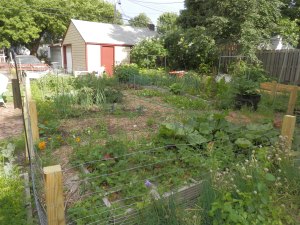
    This is the primary backyard garden. I have 2 dozen tomato plants, as well as onions, chives, leeks, kale, beets, lettuces, radish, carrot, peppers, bok choi, potatoes, fennel, nasturiums, marigolds, rosemary, oregano, dill, basil, garlic, rhubarb, strawberries, brocolli, brussels sprouts and cabbage.
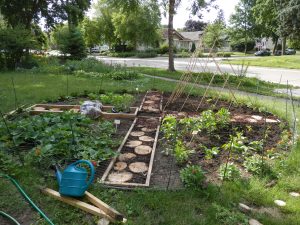
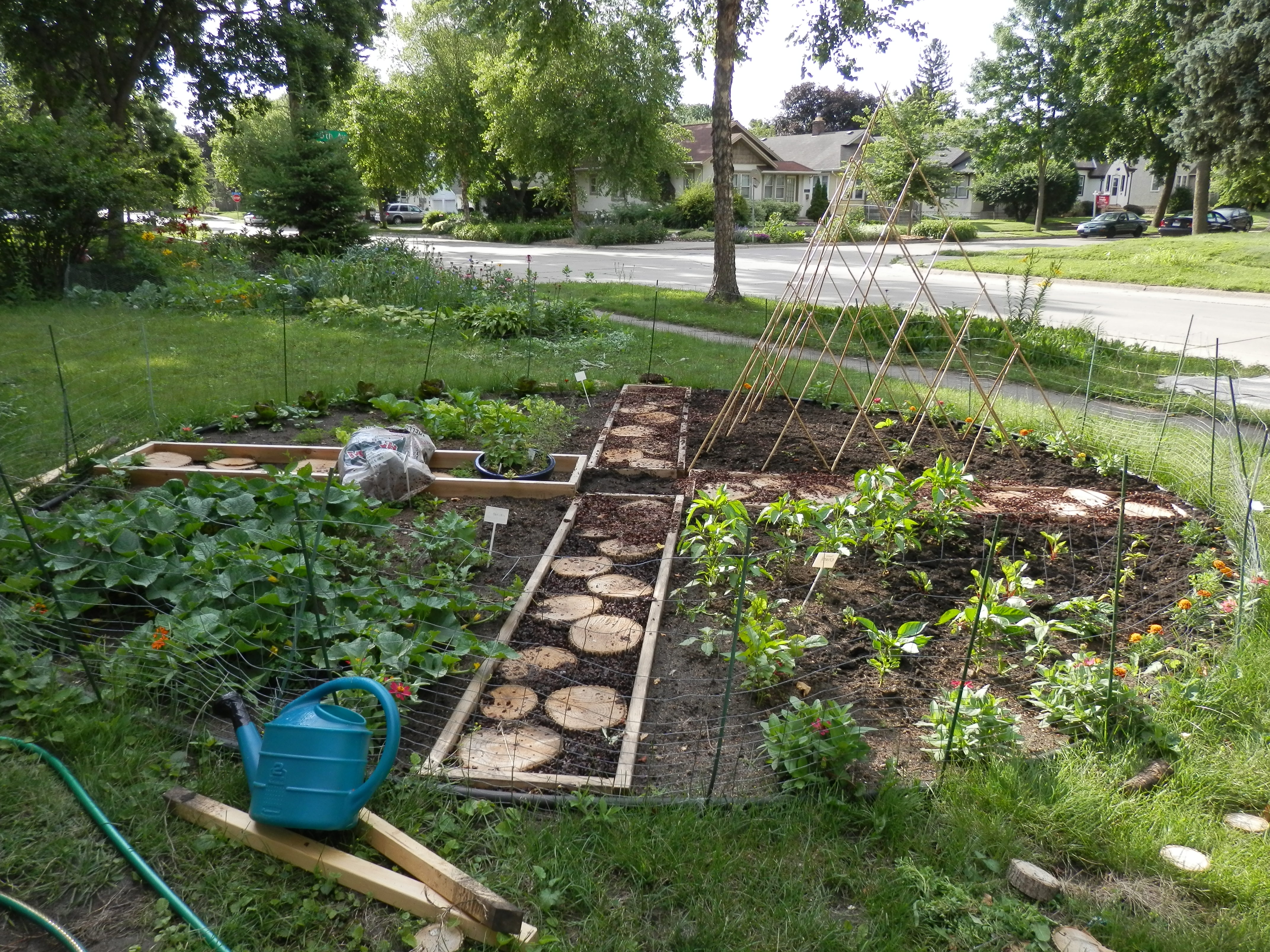
    The new round garden has a border of zinnias. One section holds cucumbers and kale. Another section holds peppers and swiss chard. One section has peppers and lettuces. One section has soil problems. I’ve added the teepee and am going to put beans there to improve the soil. I’ve purchased a bean innoculant for nitrogen fixing. The pathway is made of sections of the tree that was cut down from this spot in order to install the solar panels. We’ve used the cocoa bean husks around and under the wood sections to help hold them in place.
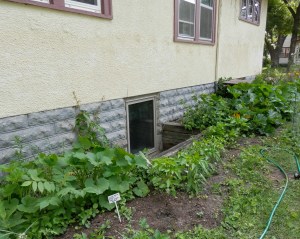
    We pulled all the flowers and weeds from here and planted squash, zucchini, peppers, blueberries and grape vines. We’ve got zucchinis all ready to pick!

    We’ve converted part of the front flower bed to collards, chard and zucchini. There has been some pest damage and they may not be getting as much sun as they’d like, but everything is growing. So far, so good.
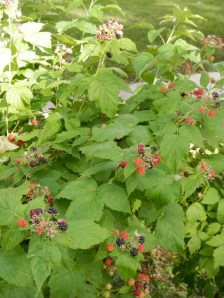
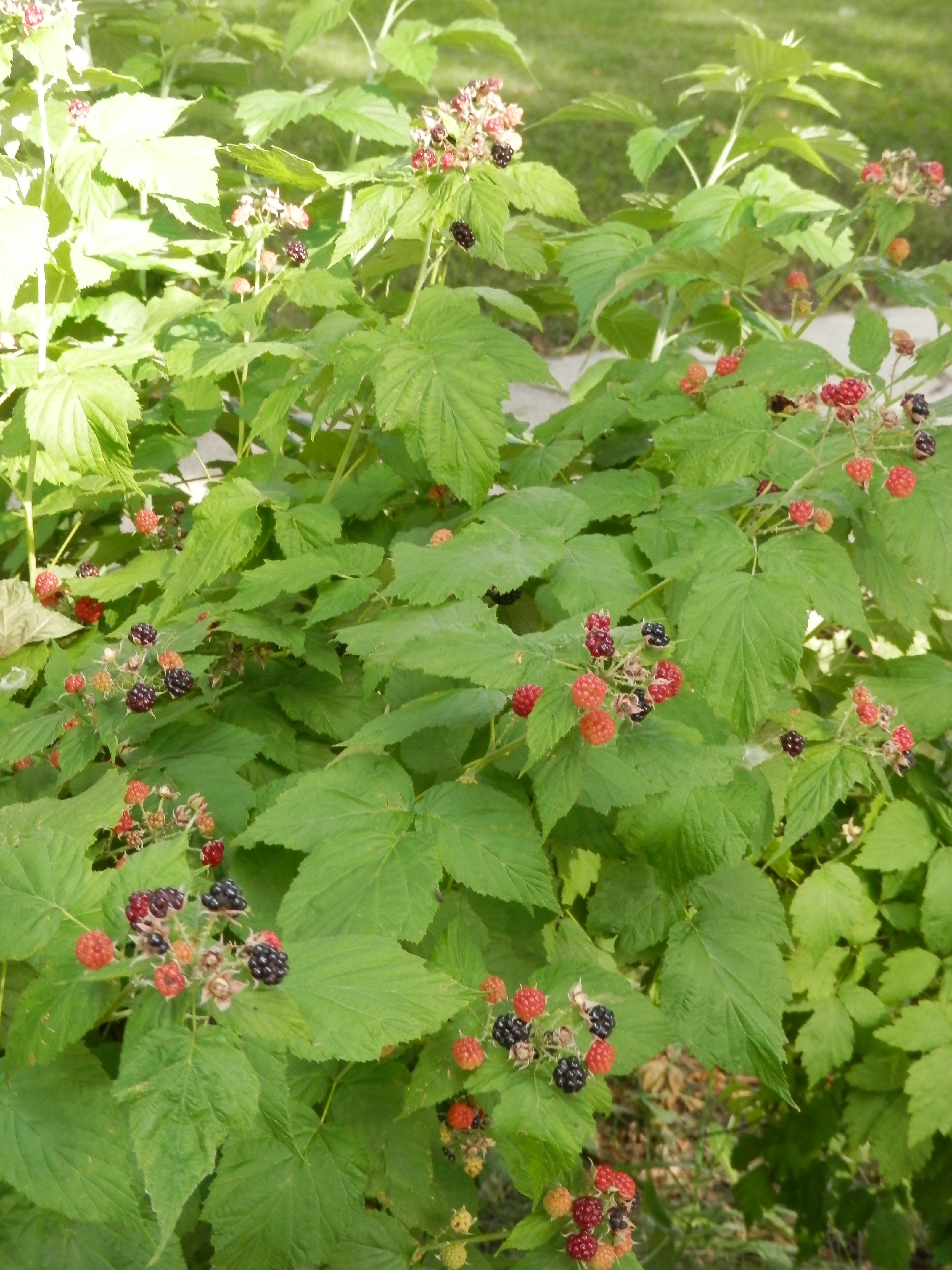
    This is a black raspberry bush that planted itself. I love the multicolored berries. We had to move our regular raspberry bushes last year to paint the garage. Two of them died, but the others are hanging in there and producing lots of fruit despite their small size. We’ve got a few blueberries on the brand new blueberry bushes and for the first time, we’re seeing a few berries on the currant bushes.

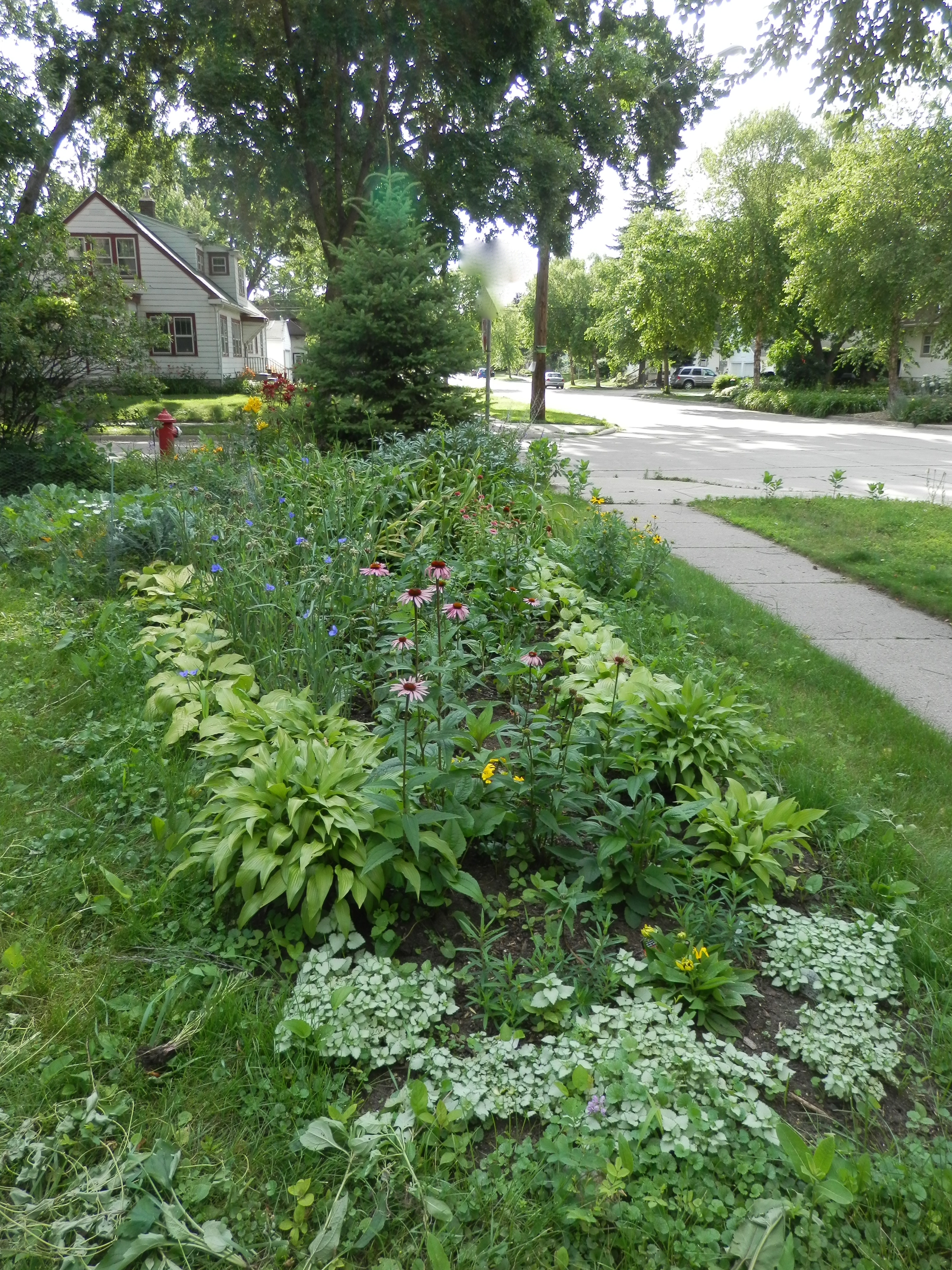
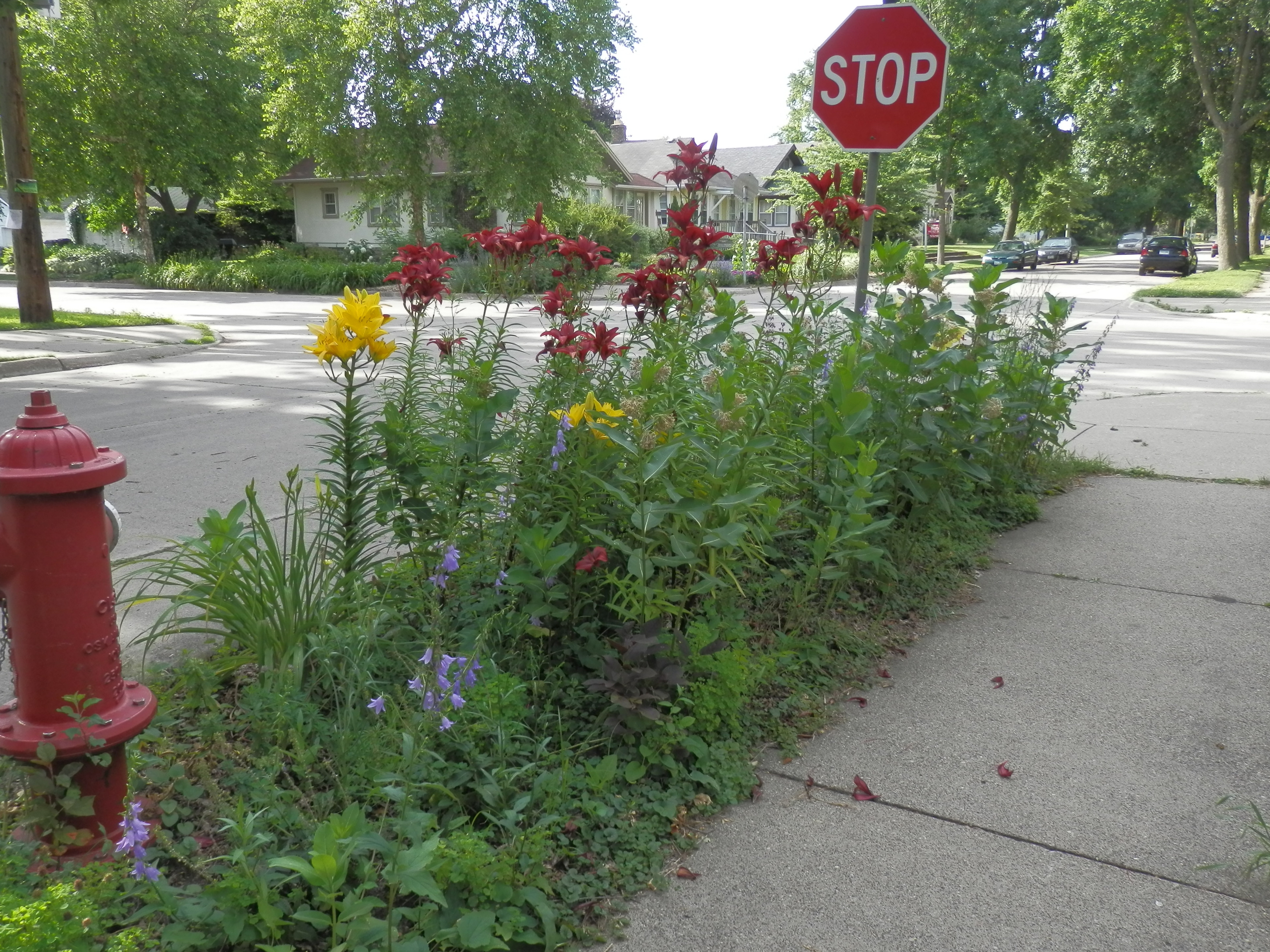
    All the plants that were removed from the side of the house were moved into a flower garden by the sidewalk. With extra shade from the boulevard trees, they are thriving.

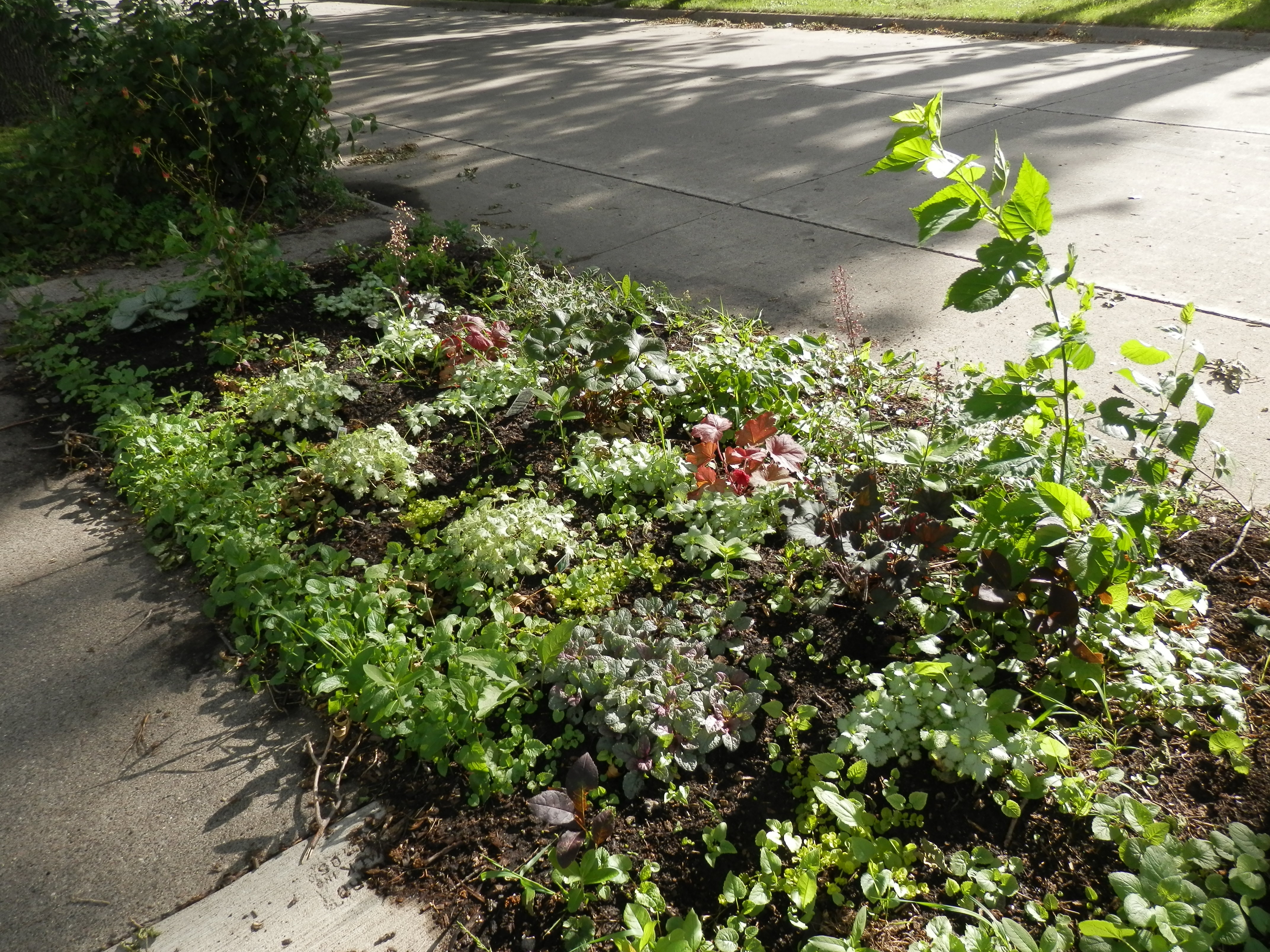
    This has long been a problem area – the front boulevard that is heavily shaded for most of the day. We’re starting over with a variety of silvers, reds and yellow-greens. It’s been 3 weeks and everything is still going strong.

    We’ve been working on this area for quite a few years. The soil was very bad, but bulbs do well here, as does the oh-so-fragrant milkweed. I added more penstemon and a couple of lavender plants, yarrow and some small silver plants.

    I don’t have photos of the work in the rain garden, which is ongoing. We added an elderberry bush, 5 ground cherries and two more horseradish plants. We’ve built three raised beds but they aren’t filled yet. There’s lots to do in this area.

    Intro to Solar Cookers

    Every year my husband’s family took a trip to Arizona to visit his grandmother. He has vivid memories of eating hot grapefruit and soggy crackers that were left in the back window. Despite those unappetizing memories, he’s willing to give intentional solar cooking a try, starting with a workshop on Monday, April 23rd, 7 – 9 pm, at Brackett Park.

    Transition Longfellow is sponsoring the presentation by Bruce Stahlberg of Affordable Energy Solutions, located right in the ‘hood, at 3535 East Lake Street. Bruce will bring several types of solar cookers with him for you to view. He’ll be talking about how solar cookers work, what kind of cooking you can do in them, what cooker works best for what type of application, and some tips on solar cooking.

    A second session will be held in May, at which time attendees can build their own solar cooker. Bruce will tell you what materials you will need to bring with you to build your cooker.

    This event is FREE, thanks to Bruce’s generous donation of his time.

    April Movies, Discussions and More

    Mad City Chickens
    April 20, 6:30 potluck; 7:15 movie; 8:30 discussion

    The Longfellow Transition group will be showing Mad City Chickens at our monthly potluck. The movie is about keeping chickens in your city yard. Some of our regular movie-night attenders are chicken-keepers so if you come for the potluck, you may be getting the inside dish on chickens and roosters at your table.

    Our guest speaker this month will be one or both of the owners of Egg|Plant Urban Farm Supply, located at 1771 Selby Ave in St. Paul. Egg|Plant sells chicks and chicken supplies and offers classes on raising chickens. (We stopped in the shop last week and it was delightful. They also sell gardening supplies, canning-dehydrating-fermentation supplies, and cheese-making supplies.)

    Hennepin County Library “Club Book” Author Event
    Sunday, April 22, 2 PM
    Ridgedale Library, Minnetonka
    Richard Louv is a journalist and author of eight books about the connections between family, nature and community. Louv’s first book, “Last Child in the Woods: Saving Our Children From Nature-Deficit Disorder,” was translated into 10 languages and published in 15 countries. His newest book, “The Nature Principle: Human Restoration and the End of Nature-Deficit Disorder,” offers a vision of the future. Book sale and signing follow presentation. FREE

    From Roots to Rooftops!

    Every month a group of folks meets at the Red Stag Supperclub near downtown Minneapolis to hear the latest developments from people working on energy and environmental issues. This month’s “Green Ideas & Ham” meeting looks at innovative water management strategies.

    Speakers John Bilotta, an educator with the U of M Extension Service on Water, and Angie Durhman, a National Green Roof Manager with Tecta America, will talk about the benefits of green roofs and landscaping in conserving and protecting clean water. John has years of experience in education and training around soil and water resources, and Annie has worked on more than 200 green roof projects including the Target Center in Minneapolis.

    This monthly breakfast forum will take place on Tuesday, March 20, from 8 to 9 am (doors open at 7:30). The Red Stag Supperclub is in near-northeast, at 509 1st Ave NE, Minneapolis, MN 55413.

    The cost to attend the talk and for a fabulous farm-fresh breakfast (I can attest that it is really good) is $15 total. Donate $5 online at Environment Minnesota, which reserves you a seat, and come prepared to pay $10 to the Red Stag server at your table. (Note: the Red Stag does not accept checks).

    Movies, MayDay and More in March

    Bell Museum Sustainability Series — all movies showing at the Bell Museum (University of Minnesota); $5 donation
    Up the Yangtze – March 1, 7:30 pm: The Three Gorges Dam, the world’s largest mega-dam provides the epic and unsettling backdrop for this award-winning film. At the edge of the Yangtze River, not far from the Three Gorges Damn, young men and women take up employment on a cruise ship, where they confront rising waters and a radically changing China. This dramatic and disquieting documentary explores life inside the 21st century Chinese dream and the landscapes and inhabitants it impacts.

    The Greenhorns documentary screenings
    The Greenhorns is a 45-minute documentary telling the stories of the young farmers who are the face of the Agricultural Renaissance. The Greenhorns is also a national non-profit with the mission to recruit, support, and promote young farmers in America.

  • March 8th at Macalester College in St. Paul, 7 PM in the James B.
    Wallace auditorium in the basement of the Campus Center. Sponsored by MPIRG.
  • March 12th at Bryant Lake Bowl, 7-9 PM, with a panel to follow. Sponsored by the Land
    Stewardship Project.
  • March 27th at the Casket Cinema in the Casket Arts Building in NE Minneapolis, 7-10 PM with panel discussion after movie.
  • MayDay 2012 Planning and Activities
    Planning has begun for the 2012 MayDay Parade & Festival and your input is needed. Join a brainstorming meeting on Tuesday, March 27 – 7-9 pm, at the Heart of the Beast Theater building on Lake Street near Bloomington Ave. Bring your ideas, concerns, hopes and dreams about building a sustainable future — and bring your friends and neighbors! This brainstorming will shape the parade and festival. Puppet and float making occur in April.

    A group of folks will be gathering on Friday, March 2, from 12-12 at Heart of the Beast Theater to brainstorm ideas surrounding the food justice and compost component of the parade, which they will then bring forward at the larger planning group. If local food and food justice inspires you, please attend this brainstorming session.

    In the Heart of the Beast has a GREEN TEAM that will be working on energy, food and waste for the festival itself. Volunteers are needed for each of these ventures.