Category Archives: Food/gardening

The First Permaculture Ethic: Care For the Earth

vegetable walk

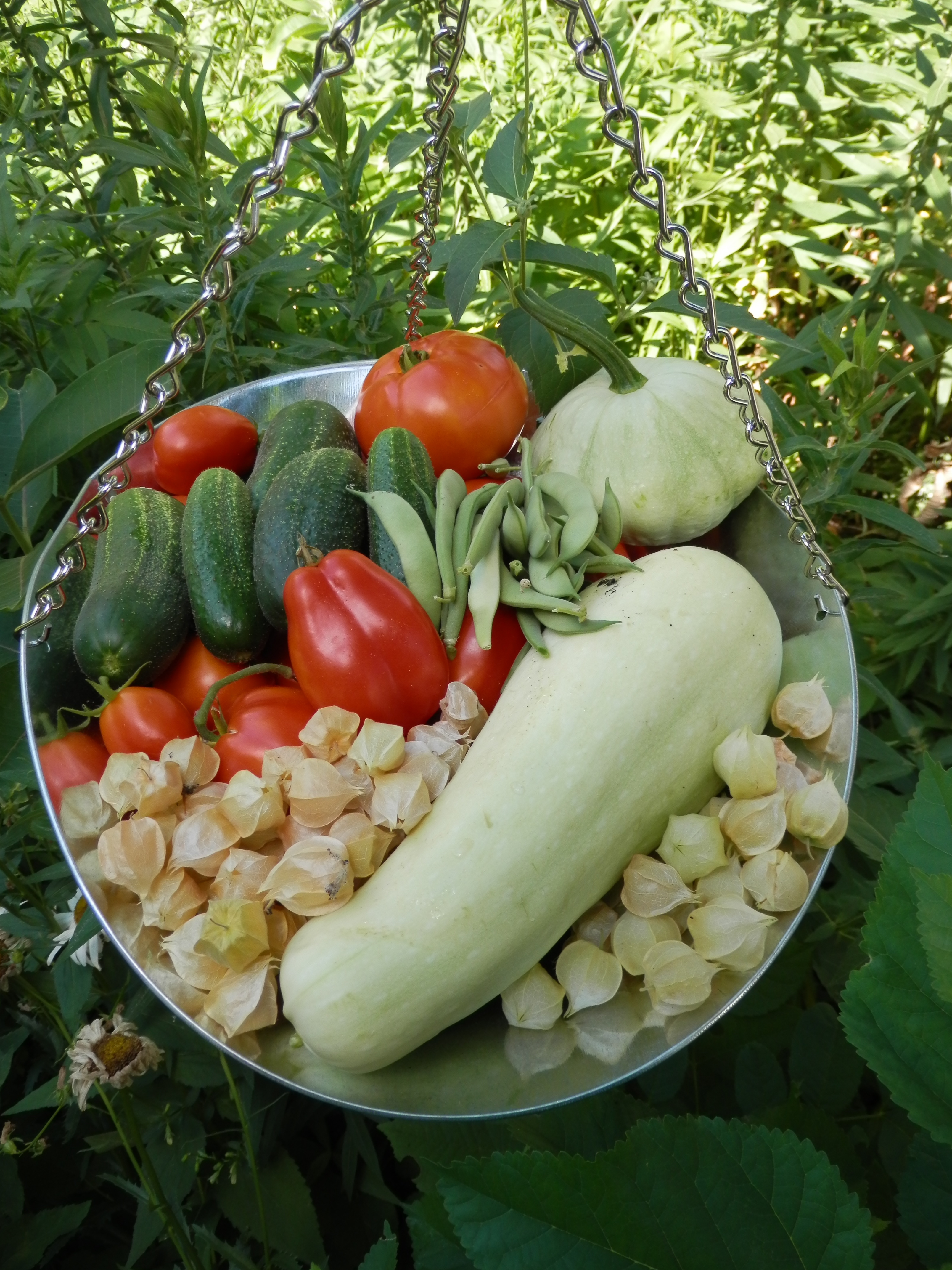
A walkway of cabbage, turnips, chard, amaranth, ground cherries and horseradish

The earth – at least in my beautiful part of the world – is naturally fruitful. Before I knew about permaculture, I spent many years benefitting from earth’s bounty without giving much thought to the fact that what I was doing was making constant withdrawals from its store of nutrients. I thought of fertilizer as something for plants, not as something for the soil.

As I got serious about vegetable gardening, I came to understand that I needed to rebuild the soil. That replenishment couldn’t be an after-thought – “I think I’ll add some fertilizer this year.” The soil needed to come first!

For Love of Compost

Years ago we got one black plastic barrel, put stuff in it, and waited while it did nothing. It was impossible to turn the material over and we didn’t know compost breaks down faster with rain and sun. We tried a different container – still no luck. It got overly full.

Finally we built an open wire and wood, 3-bin composting center. We keep a pitchfork available and my husband turns it regularly. Now we’re cooking – compost, that is!

We add compost into the garden beds every year. We use the worm castings to make worm tea, which is a nutrient-rich addition that can protect and nourish plants.

Hoarding water with mulch

It took me even longer to learn that the best water is what’s in the soil, not what’s in the hose. Now I use straw mulch but if we had a lawn mower with a bag (and enough lawn) I could use grass clippings. Maybe I’ll start asking my neighbors for their grass clippings because sharing the bounty is also one of the ethics of permaculture and I bet they don’t think of their grass clippings as one of the yields they obtain.

Personal Permaculture: The Bigger Picture

With only 1/10th of an urban acre, it’s pretty clear that the greatest impact I have on the planet and its resources is not as a gardener, but as a consumer. Like most Americans, I consume more than my fair share of the world’s natural resources in terms of food, water, minerals and fossil fuels. Every time I buy something, the permaculture ethic of care for the earth asks me to consider whether I really need it.

After all, there’s not much I can do to rebuild the world’s store of iron ore or titanium or tungsten, but if I don’t buy that extra thing, more of those resources stay in the ground. And if I give my usable, previously purchased possession to someone, or share it with friends and neighbors, then someone else doesn’t have to buy it and those resources won’t be needed.

Recycling helps. It puts at least some of these valuable resources back into the stream of production and it keeps them out of the stream of waste, where they may actually be toxic.

But reduce helps more. That should be my goal.
Reflections on Two Seasons of Permaculture

OLYMPUS DIGITAL CAMERAFor the past two years, I have participated in a monthly conversation about permaculture, hosted by Transition Longfellow and facilitated by Hennepin County Master Gardener Theresa Rooney (and me). That conversation comes to an end this month. Since I haven’t written about it before, I thought now would be a good time to take a look back at what I’ve learned from the permaculture principles and ethics, what I’ve put into practice in my garden, and how the principles have played a larger role in my life.

The thoughts expressed in the blog posts about permaculture that will follow may or may not be “from the book.” It’s my take on what I’ve learned in the discussion group, in classes at the Permaculture Research Institute for Cold Climates and at gatherings like the permaculture convergence in Harmony, Minnesota that I attended in 2013.

What Is Permaculture?

Permaculture originated from the work of David Holmgren and Bill Mollison. It is a landscape design method and it’s a philosophy. It takes its cues from natural systems, which are extraordinarily abundant. Every year nature manages to produce multiple yields for plants, animals and people. How does nature manage to do that? It’s regenerative. It’s cyclical. It uses “waste” to create anew. Permaculture is also called “regenerative design.”

Permaculture recognizes that the benefits we obtain from our environment cannot, for long, come at a cost to the natural world. Unlike a company or a country, a planet cannot run a deficit. The well simply runs dry. So permaculture principles guide human activity in a way that seeks abundant yields, that acknowledges limits,and that recognizes the need to provide inputs into the system to rebuild natural resources like the soil and water – and people. We’re part of the natural system, too.

I’ll do one post each on the ethics and the principles, which are these:

Permaculture Ethics

  1. Care for the Earth
  2. Care for People
  3. Fair Share

Permaculture Principles

  1. Observe and interact
  2. Catch and store energy
  3. Obtain a yield
  4. Apply self-regulation and accept feedback
  5. Use and value renewable resources and services
  6. Produce no waste
  7. Design from pattern to detail
  8. Integrate rather than segregate
  9. Use small and slow solutions
  10. Use and value diversity
  11. Use edges and value the margins
  12. Creatively use and respond to change

This month I’ll post about each of the ethics, then beginning in January I will do one post a month about one of the principles. I welcome comments on what these ethics and principles have meant in your life and practice.

Kitchen Remodel to Reduce Food Waste and Organize Recycling

Reducing Waste in the Kitchen

The kitchen is not only the location for much of our household consumption, it’s also the source of much of our household waste production, including one of the worst greenhouse-gas-producing waste products — food waste.

A Few Facts About Food Waste

According to a National Resources Defense Council report, getting food from farm to table uses 10% of our nation’s energy budget. This morning on MPR, Jonathan Foley, director of the Institute on the Environment at the University of Minnesota, said that we use about 40 percent of the (non-ice-covered) land on the planet to grow food, and “70% of all the water we consume is used to irrigate crops.” Agriculture is one of the biggest contributors to climate change.

That’s an extremely costly food chain and yet approximately 40% of all food produced in the world is never eaten. According to the EPA, 21% of our municipal waste is food waste. More food goes to landfills and incinerators than any other type of material.

Not only are we losing an estimated $165 billion in food that could be used to feed hungry people, but food in landfills produces methane as it decays. Methane is 21 times more potent as a greenhouse gas than carbon dioxide so this is a very big deal. Landfills are the source of 20% of all methane emissions.

Our Goal: Reducing Food Waste

Continue reading

The Garden Adventure Begins Again

Last year I “graduated” from the urban farming program at the Permaculture Research Institute for Cold Climate. I don’t believe I achieved “expertise,” but I did gain some useful knowledge, I devoted much more time to my garden, and I have become part of a  community of food growers. It was a good experience that left me eager to see what I could do the next growing season.

The Plan for 2013

Continue reading

Find Funding to Start Something

I’ve been doing research on foundation and government money available for urban agriculture, climate action and sustainability. I was pleased to learn that the McKnight Foundation and 3M Foundation are putting significant resources into climate action (though not through open grantmaking). McKnight committed $100 million to fight climate change, working with other foundation funders in a network called ClimateWorks.

I thought I’d share a few of the resources I found to raise money for youth and community projects. I’ll revisit this theme in future.

Continue reading

Personal Permaculture 1: Observe and Interact

During the first discussion of the Personal Permaculture group, after hearing the principles and ethics, people shared their thoughts about the principle of observation and interaction. A couple of things struck me as particularly important areas to pay attention to this month: measurement, tracking and how we talk about sustainability (we personally, and the media in general).

Continue reading

Personal Permaculture Discussion

We started the Personal Permaculture discussion group last Saturday morning at the Riverview Wine Bar. Some people are interested in learning about permaculture as it applies to their land; others are interested in understanding the principles in a broader context. That’s why we’ve called in “personal” permaculture. This week we reviewed the 3 ethics, the 12 principles and the concept of zones. I’ll go over those quickly here.

Continue reading

Emergency Preparedness and the Long Emergency

Preparedness Discussion Group

This group began in November 2012 after a few members watched the video Peak Prosperity and began talking about how to prepare for immediate emergencies and the “long emergency” of climate change. We aren’t showing the video to the group because it is too sales-oriented, but we do find information on the peak prosperity website to be useful, particularly the “What Should I Do?” list.

This is a complex, and emotionally challenging topic for many in the Transition movement. The majority of websites that discuss preparedness – and that sell preparedness products – have a distinctly militaristic and apocalyptic attitude. The peak prosperity site also has some of these discomfiting elements, but we encourage people to read the section on Community to understand that we are not advocating disregard for one’s neighbors. Chris Martensen uses an airline emergency as a metaphor: By taking steps to prepare ourselves, we are putting our own oxygen mask on first so that we can then assist the person next to us. We ARE in this together.

The group meets on the Third Tuesday of each month (various locations) from 6:30 to 8:30 pm. Topics include:

  • December 18, 2012: Water — How do we meet our personal need for water, and our food garden’s need for water, in the event of a short-term emergency or longer-term drought? How would our community/city provide safe drinking water if our water system were to be damaged or compromised by storm or flood or loss of electricity?
  • January 15, 2013: Heat – How do we heat ourselves in an emergency situation, such as being stuck in the car in a snowstorm or while camping? How do we heat our home in the event of a power outage (remember, gas furnaces use electric fans to move heat)? In the event we have no heat, how do we prevent cold-damage to our homes? What are the environmental consequences of different types of backup heat? How can we minimize that damage?
  • February 19, 2013: Electricity – What are your household’s critical electrical needs? In the event of a short-term power outage, what backup system do you have in place? What are the environmental consequences of different types of backup electricity? What alternatives do we have to the electrical grid should electricity become unreliable or too costly over the long term? What can we do as a community to bring improvements to our grid and our energy future?
  • March 19, 2013: Food 1 – How much food should one keep on hand in the home or in the car in case of short-term emergency such as a weather disaster? How does one’s food storage outlook change when considering the “long emergency,” when drought and weather instability may lead to crop losses and increased food prices? (What did our foremothers do to get through the winter?) What has been done on a governmental/ community level to store food in case of crop loss/food shortages?
  • April 15, 2013: Food 2 – What kinds of food should be in the “deep pantry?” What is the best balance of growing your own versus buying from local farmers versus buying from the store? What would a good food storage area look like?
  • May 21, 2013: Food 3 – What are the best methods for storing or preserving food? In what situations might one need a backup system for cooking food? For freezing food? What are the environmental consequences of different types of backup systems?
  • June 18, 2013: First Aid and Health – How prepared are you to handle a sprain, a broken bone, an infection or burn? Do you have adequate emergency supplies in your home and your car? Do you have a small kit on your bike? What health maintenance resources are available within the community? Who in your area understands  no-cost or low-cost natural health treatments?
  • July 16, 2013: Finances – If your home is destroyed by a tornado, will you be able to access your money and credit? Are important documents stored safely offsite? In the face of the long emergency, how might our financial system change? What constitutes real wealth?
  • August 20, 2013: Community – What does a resilient community look like and what steps can we take to help build resilience? How can we take what we’ve learned and share it? What institutions in our community can be a resource for preparedness? For example, if a tornado destroyed homes in this area, are there churches that would open their doors to those made homeless?

Personal Permaculture Discussion Group

Transition Longfellow will be hosting a year-long conversation on Personal Permaculture. January’s kickoff meeting will feature Longfellow master gardener Theresa Rooney. She will provide an overview of permaculture, introducing and explaining the principles and ethics. To learn more, see the Personal Permaculture page under Discussions.

  • Location: Riverview Wine Bar on 42nd Avenue and 38th Street, Mpls
  • Time: 10:30 to noon
  • Dates: First Saturday of each month

Acknowledging Trade Offs when it Comes to Saving Water

Oil and Gas versus Water

The greater the distance your food travels to get to your table, the more oil-dependent your lifestyle. Saving energy is one reason why we’ve expanded our fruit and vegetable production. Freshness and knowing that it was safely grown are other reasons. But gardens themselves take resources, particularly water.

Although we’ve had somewhat decent rainfall this year in Minnesota, fresh water is a valuable resource that really needs to be conserved. We have only one rain barrel and we haven’t always used it well. We want a multi-barrel system with a pump but we’re not there yet. Even the multi-headed sprinkler system I set up hasn’t been working properly. Next year I’m going try the newest low-tech watering trick every garden website is showing – plastic pop bottles planted upside down near voracious plants like tomatoes.

We eat something from the garden almost every day, but I’m also learning to process vegetables for winter. I’m most familiar with water-bath canning. I can tomatoes, sauce and pickles – things with high amounts of acid. It takes quite a lot of water to wash the vegetables and to fill the canning pot. And it takes a fair amount of natural gas to heat all that water. If I’m going to be canning two days in a row, I save the water in the canning pot, but I have a very small and inefficient kitchen. I can’t keep a huge pot of water sitting around. If it’s not going to be used soon, we “water” the compost bin (compost breaks down faster when it’s got the right amount of moisture) or the veggies with it.

Canning together saves resources and is a lot more fun.

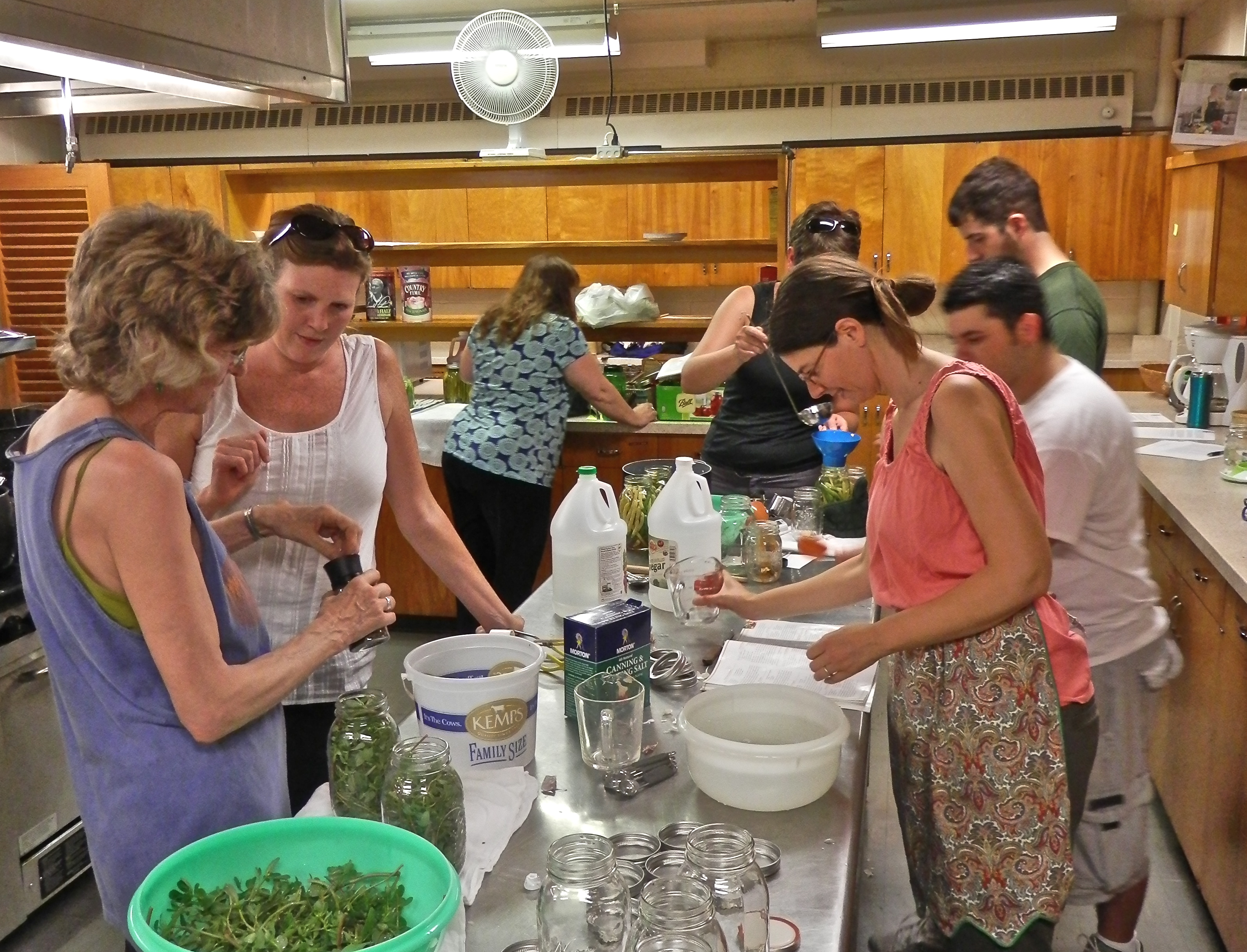
In the past month, I’ve been canning with my neighborhood Transition group (Transition Longfellow). As part of our reskilling efforts, we’ve been teaching folks how to pickle veggies and can tomatoes. By doing these projects together in small groups — many people using the same water bath — we save water and natural gas.

I recently bought a pressure canner so I can process low-acid foods like beets and green beans and meat. At first I couldn’t understand why people said it was more efficient because a pressure canner takes far more time to process foods. Now that I’ve done my first batches of soup and broth, I understand. The pressure canner uses only a couple of quarts of water – as opposed to many gallons used in the water canner – and once it reaches boiling, I can turn the gas to the very lowest setting. Pressure keeps the heat high.

I’ve got two more food preservation methods to learn: dehydrating and fermenting. I’ve just bought a pickling jar to ferment cucumber pickles and a glazed crock to ferment cabbage for sauerkraut, both from EggPlant Urban Farm Supply. They also have a glazed water-seal pot for pickling, which is locally made. I’m in love with it but it’s too expensive for me.

Ultimately, I need to learn more about methods of food preservation that use fewer, or more easily available resources. I’ve ordered two books on this: