That Frackin’ Song: Can’t get it out of my mind
Leave a reply

On the Longfellow Sustainability Group Facebook page we’ve been talking about wind energy and how it may be a more affordable energy alternative than solar. As I noted in my post on the movie Windfall, most solar installations are overpoweringly large – certainly not something a typical homeowner can take advantage of.
We saw an urban-friendly wind turbine at the Living Green Expo last week and one of our group members has explored it further. Minnesota Wind Energy offers several small turbines. Their website is terrible. Their brochure is equally bad. But they appear to be the only game in town. Here’s what friend Annette found out about these units, which can be installed on the ground or on a rooftop.
The US government offers a 30% tax refund and rebates from the state or Xcel may be in the works.
Looking for more info on wind? Group members suggested:
At this week’s Longfellow Sustainability Group, a tenant expressed frustration with her inability to turn down the heat. We know quite a few people who have to keep the window open in mid-winter to cool down their overheated apartments. We feel for you. We don’t have any answers from personal experience, but you might want to check out this blog “Green Tenant.” And here’s a “how-to go green” rental article from Mother Nature Network.
We attended the solar workshop at Mathews Park on Monday night and found that solar heating and solar water heating — once a long-term dream — is now within reach. “Make Mine Solar” is a bulk purchase program for residents of Minneapolis, St. Paul and first-ring suburbs.
Through this program you can get two different hot water systems and one solar air heat system. The program explains the various rebates and tax credits available, as well as where you can get bank loans. There are several certified installers available to work with you. They will provide a list.
After state rebates (which end September 2011) and federal tax credits (which run through 2016), the cost is:
The cost for a solar site assessment, which usually runs $250, is now $90 (for one technology) or $120 (for both). You may need a structural review of your home, which runs $500. There could be other costs, depending upon where your hot water system is located and whether you want cosmetic covering of exterior pipes.
I attended a screening of the movie “Windfall” at the Bell Museum, where it was being shown as part of the Sustainability Film Series. The director was there to answer questions. Someone was standing outside handing out flyers pointing out the misinformation in the film. I hadn’t expected controversy to be part of the sustainability film series, but I can see why it was.
We hear from our friend in the know that this is a really big — and wonderful — event for anyone with a serious interest in energy and sustainability. Check it out at the Midwest Renewable Energy Assn website.
The MREA Energy Fair transforms rural Central Wisconsin into the global hot spot for renewable energy education. The Energy Fair brings over 20,000 people from nearly every state in the U.S. and several countries around the world to learn, connect with others and ready them for action at home. The Energy Fair is the nation’s longest running energy education event of its kind, featuring:
The Energy Fair is held in Custer, WI just seven miles east of Stevens Point. That’s 224 miles from Minneapolis, folks. If people are interested in attending, let’s talk about renting a passenger van or carpooling. There is camping on location.
A few stats from treehugger.com
Home electronics take energy and add up to waste, but if you are going to have some of them, there are things you can do to minimize the problem.Treehugger also has a guide to Green Computers and some other ideas on going green with your home electronics.
Greenpeace has a produced a guide to electronics that looks at how “green” they are in terms of pollution. Here’s a link to the Green Electronics Guide.
Finally, take a look at Epeat, a global registry for green electronics.
A nice little video from the folks at the PostCarbon Institute
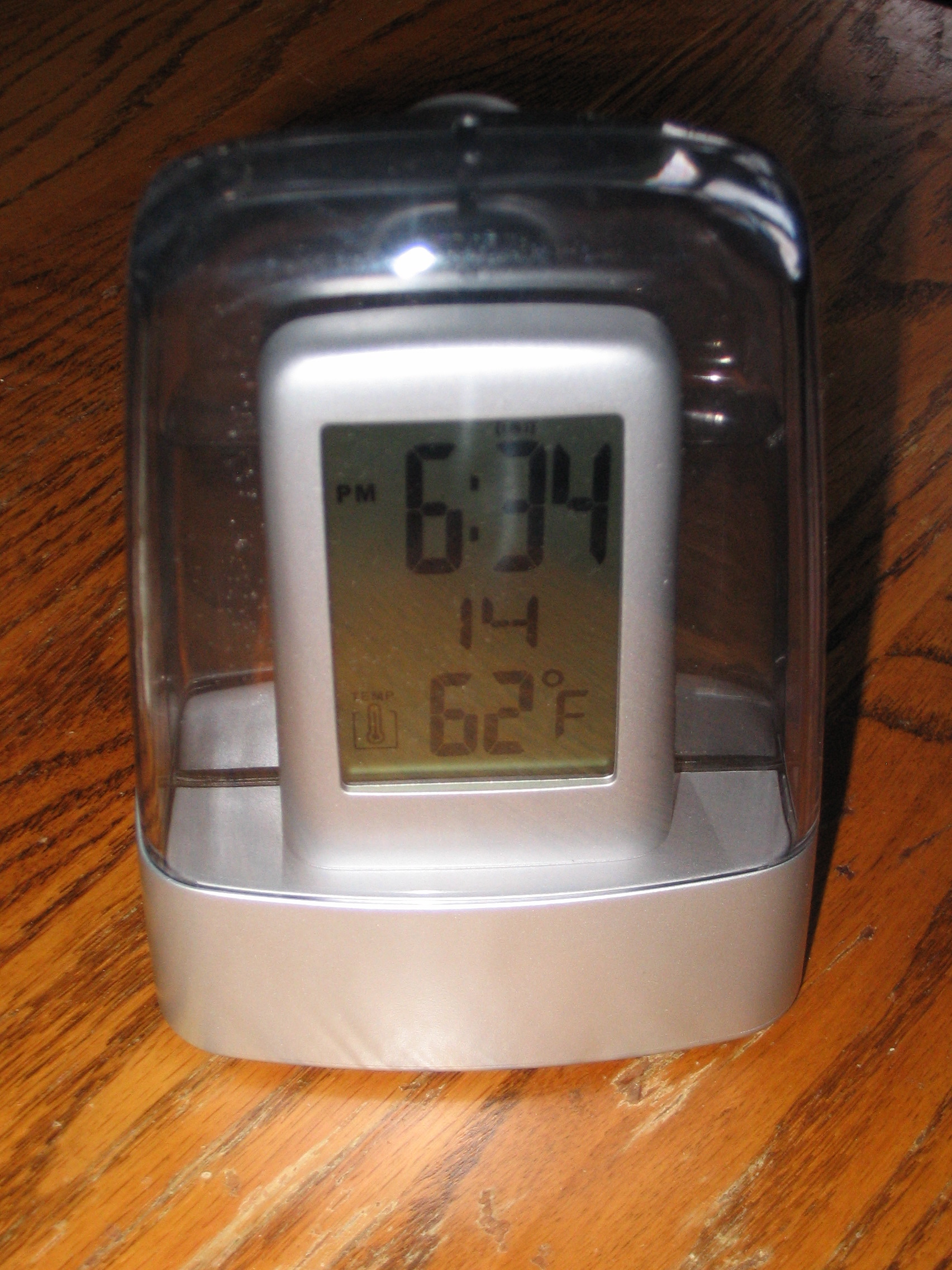
I need an alarm clock but I don't need to use electricity. Here is the water-powered alarm clock we got yesterday.
According to the Consumer Electronics Association, in 1975 the average household had fewer than two electronic products. In 2007, the average household had 25 consumer electronic products (computers, DVD players, video game consoles, cordless phones, digital cameras, high-def televisions).
It’s going to take a lot more than energy efficient lightbulbs to make a dent in runaway energy use. It’s going to mean taking a long, hard look at what we are using electricity to do. I’ve been going room to room, looking at what’s plugged in and asking myself:

carpet sweeper
In the past week, we’ve replaced 2 items that use electricity. The water-powered digital alarm clock pictured above tells you time, date, temp and has a decent, though not overly loud, alarm. You need to change the water once every two weeks to keep it running. It is not backlit – which can be both a blessing and a curse. We’ll see.
We also bought a carpet sweeper (again, from Lehmans) to reduce the use of the electric vacuum cleaner. This thing sure does a good job picking up cat hair. And I might develop some arm muscles using it… which wouldn’t be bad.
A large number of electrical products draw power (phantom load) as long as they are plugged in. They have to be unplugged in order to draw no power — or plugged into a “smart strip” type powerstrip (like these smartstrips at Choose Renewables) that turns itself off when it senses the product is not in use .
Wondering about how much energy your various appliances and electronics use when on, off, or on standby? Here’s a useful website from Lawrence Berkeley National Laboratory. You may be surprised. Here are two tables:
 Think of It As An Adventure