Author Archives: thinkofitasanadventure

Unknown's avatar

About thinkofitasanadventure

My husband Peter and I attended a sustainability conference with Richard Heinberg of the Post Carbon Institute in 2010. We learned some hard truths about climate change that shook us to our core. We knew we needed to transition away from fossil fuels as soon as possible, for the sake of our children. We initiated a neighborhood Transition group (Transition Longfellow). It became the center of our lives. In 2019, we downsized and moved to a tiny rural village. It's a whole new way of life and we've got a lot more learning to do. We're choosing to continue to "think of it as an adventure."

The Second Permaculture Ethic: Care For People

Permaculture puts care for people and community on equal footing with care for the environment. Human beings are PART of the system, not apart from it. We have a vital role to play in caring for the earth and by doing so we are also caring for each other.

How Does This Ethic Apply in My Yard?

Our yard provides benefits to the people in our house and the people in our community.

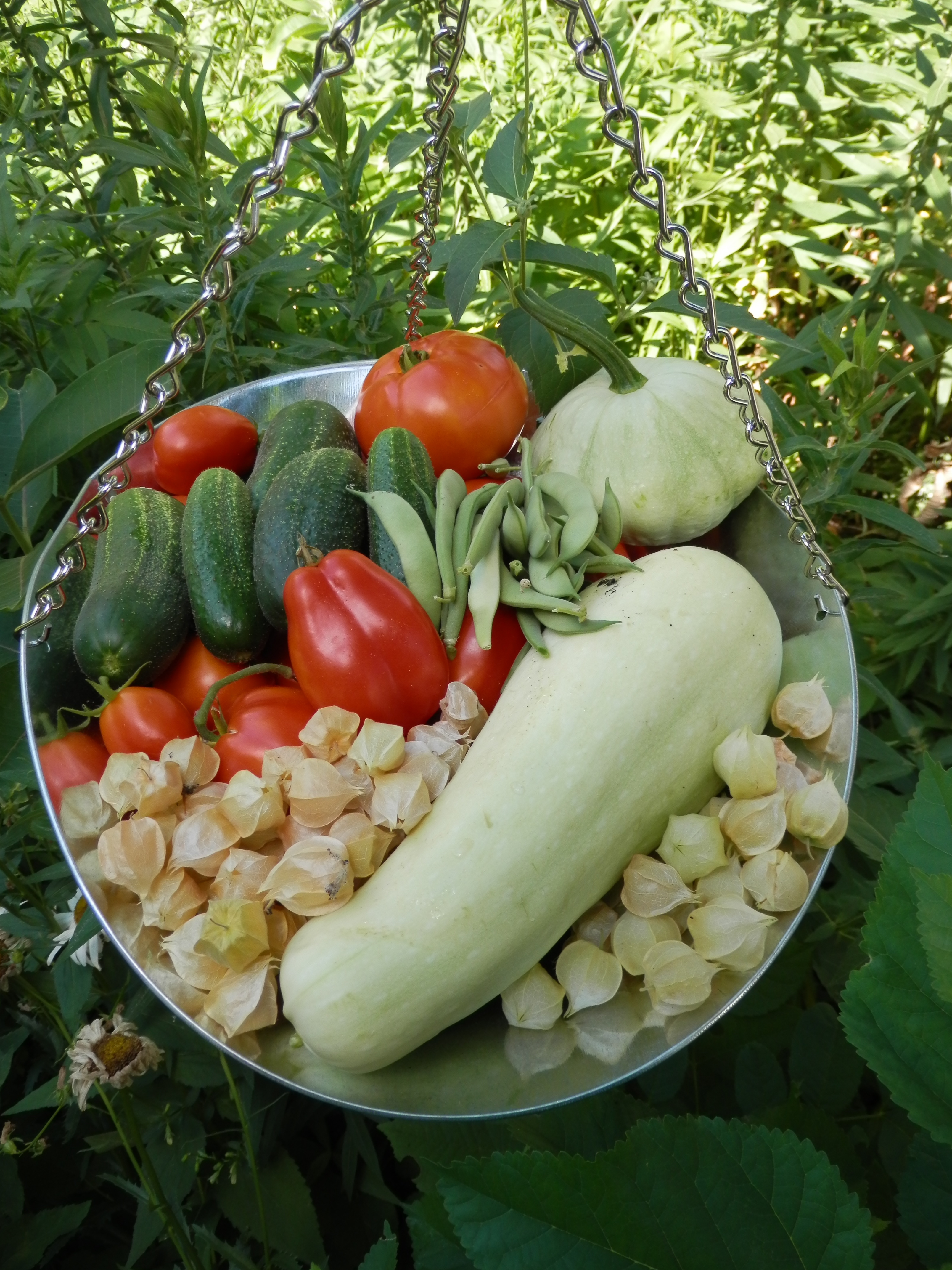
  • We grow food. When I plan what food I want to grow I plan for health needs, to please people, and to share. I add cherry tomatoes for my husband. I add ground cherries for my nieces and neighborhood children. I grow greens for my health.
  • The act of working with the earth by gardening an act of caring for the earth and for myself. It’s a healthy outdoor activity. It’s a good excuse to move around and gets me out in the sunshine.
  • Gardening leads to many great opportunities to talk with neighbors, especially seniors and stay-at-home moms out walking the babies. Everyone wants to talk when they see you in the garden. It builds community networks and an active street life makes the neighborhoods safer.
  • The flower garden brings beauty to passersby and makes our whole neighborhood more pleasant.
  • The garden is a learning place. Last fall a 2nd grade class visited from a nearby school. I gave the children a tour and taste.
  • When planning how to fit everything into our small space, we made sure to include an area for rest, relaxation and enjoyment of nature.
  • We enjoy having friends and neighbors over in the evening to socialize but we noticed that our plastic lawn chairs were flimsy and possibly unsafe. This year we built a really sturdy bench, just in time for National Night Out. We had 30 neighbors here that night!
  • Our little free library allows us – and lots of our neighbors – to share knowledge and entertainment with others. At least a handful of people stop to browse every day.

What’s Next in Caring for People?

little free library

Our little free library is busy every day

We’re eyeing the space by the little free library as an area where we can continue to share and care for our community.

  • We want to build a bench so people can sit and look at the books.
  • We’d like to add an information area where we can post information about the neighborhood sustainability group.
  • I’d like to add a couple of cherry tomato plants right by the library post.
  • I’d like to put a dog watering station there, too, but it’s so far from the house that I don’t know how I’d keep it filled with water. So that’s just an idea for the time being.

The First Permaculture Ethic: Care For the Earth

vegetable walk

A walkway of cabbage, turnips, chard, amaranth, ground cherries and horseradish

The earth – at least in my beautiful part of the world – is naturally fruitful. Before I knew about permaculture, I spent many years benefitting from earth’s bounty without giving much thought to the fact that what I was doing was making constant withdrawals from its store of nutrients. I thought of fertilizer as something for plants, not as something for the soil.

As I got serious about vegetable gardening, I came to understand that I needed to rebuild the soil. That replenishment couldn’t be an after-thought – “I think I’ll add some fertilizer this year.” The soil needed to come first!

For Love of Compost

Years ago we got one black plastic barrel, put stuff in it, and waited while it did nothing. It was impossible to turn the material over and we didn’t know compost breaks down faster with rain and sun. We tried a different container – still no luck. It got overly full.

Finally we built an open wire and wood, 3-bin composting center. We keep a pitchfork available and my husband turns it regularly. Now we’re cooking – compost, that is!

We add compost into the garden beds every year. We use the worm castings to make worm tea, which is a nutrient-rich addition that can protect and nourish plants.

Hoarding water with mulch

It took me even longer to learn that the best water is what’s in the soil, not what’s in the hose. Now I use straw mulch but if we had a lawn mower with a bag (and enough lawn) I could use grass clippings. Maybe I’ll start asking my neighbors for their grass clippings because sharing the bounty is also one of the ethics of permaculture and I bet they don’t think of their grass clippings as one of the yields they obtain.

Personal Permaculture: The Bigger Picture

With only 1/10th of an urban acre, it’s pretty clear that the greatest impact I have on the planet and its resources is not as a gardener, but as a consumer. Like most Americans, I consume more than my fair share of the world’s natural resources in terms of food, water, minerals and fossil fuels. Every time I buy something, the permaculture ethic of care for the earth asks me to consider whether I really need it.

After all, there’s not much I can do to rebuild the world’s store of iron ore or titanium or tungsten, but if I don’t buy that extra thing, more of those resources stay in the ground. And if I give my usable, previously purchased possession to someone, or share it with friends and neighbors, then someone else doesn’t have to buy it and those resources won’t be needed.

Recycling helps. It puts at least some of these valuable resources back into the stream of production and it keeps them out of the stream of waste, where they may actually be toxic.

But reduce helps more. That should be my goal.

Reflections on Two Seasons of Permaculture

OLYMPUS DIGITAL CAMERAFor the past two years, I have participated in a monthly conversation about permaculture, hosted by Transition Longfellow and facilitated by Hennepin County Master Gardener Theresa Rooney (and me). That conversation comes to an end this month. Since I haven’t written about it before, I thought now would be a good time to take a look back at what I’ve learned from the permaculture principles and ethics, what I’ve put into practice in my garden, and how the principles have played a larger role in my life.

The thoughts expressed in the blog posts about permaculture that will follow may or may not be “from the book.” It’s my take on what I’ve learned in the discussion group, in classes at the Permaculture Research Institute for Cold Climates and at gatherings like the permaculture convergence in Harmony, Minnesota that I attended in 2013.

What Is Permaculture?

Permaculture originated from the work of David Holmgren and Bill Mollison. It is a landscape design method and it’s a philosophy. It takes its cues from natural systems, which are extraordinarily abundant. Every year nature manages to produce multiple yields for plants, animals and people. How does nature manage to do that? It’s regenerative. It’s cyclical. It uses “waste” to create anew. Permaculture is also called “regenerative design.”

Permaculture recognizes that the benefits we obtain from our environment cannot, for long, come at a cost to the natural world. Unlike a company or a country, a planet cannot run a deficit. The well simply runs dry. So permaculture principles guide human activity in a way that seeks abundant yields, that acknowledges limits,and that recognizes the need to provide inputs into the system to rebuild natural resources like the soil and water – and people. We’re part of the natural system, too.

I’ll do one post each on the ethics and the principles, which are these:

Permaculture Ethics

  1. Care for the Earth
  2. Care for People
  3. Fair Share

Permaculture Principles

  1. Observe and interact
  2. Catch and store energy
  3. Obtain a yield
  4. Apply self-regulation and accept feedback
  5. Use and value renewable resources and services
  6. Produce no waste
  7. Design from pattern to detail
  8. Integrate rather than segregate
  9. Use small and slow solutions
  10. Use and value diversity
  11. Use edges and value the margins
  12. Creatively use and respond to change

This month I’ll post about each of the ethics, then beginning in January I will do one post a month about one of the principles. I welcome comments on what these ethics and principles have meant in your life and practice.

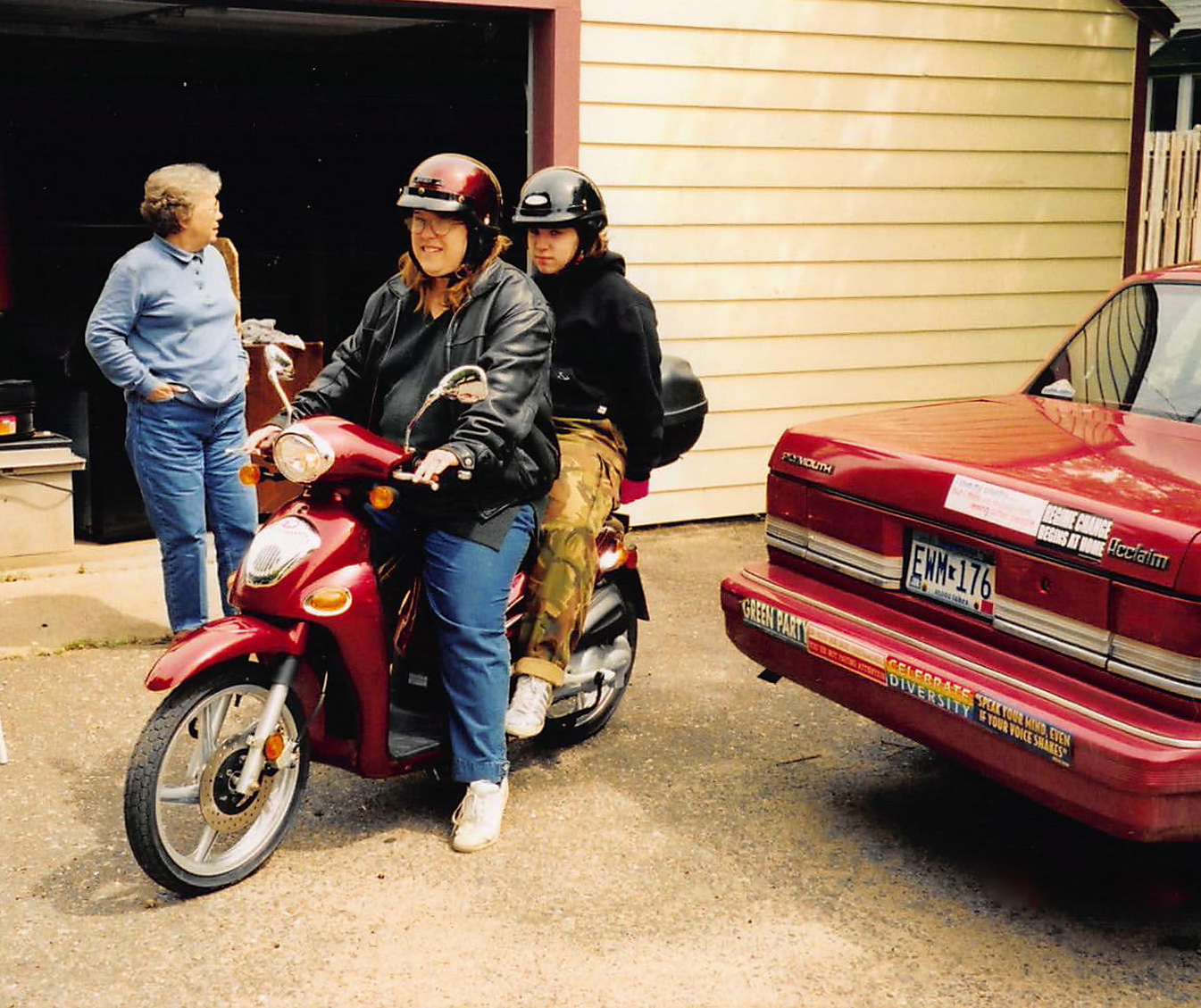
Calculating the Impact of the Motor Scooter

Leslie and Rachel head out on the scooter

Leslie and Rachel head out on the scooter

This weekend we replaced the battery on the Kymco People 50 motor scooter that Peter rides to work. With a new $50 battery in place, he zoomed off this morning in high spirits, reporting back that the odometer hit 15,000 miles! Seems a good time to take a look at the overall impact of this purchase.

Peter gets 90 miles per gallon of gas when he rides the scooter to work (10.5 miles round trip). He gets 27 mpg when driving the car. We’ve saved half the cost of the scooter in gas savings.

The burning of one gallon of gas (with 10% ethanol) produces 18.95 lbs of carbon. Driving the scooter 15,000 miles has produced 3,148 lbs of carbon (or 1.58 short tons). Driving the car the same number of miles produced 10,152 lbs of carbon (5.08 short tons). So driving the scooter prevented 6,998 lbs of carbon (3.5 tons) from entering the atmosphere.

And the scooter is fun!

The Irony of Mother’s Day

This month’s topic for the Sustainable Finances – Sustainable Life group is consumerism and today I saw the perfect example of how consumerism warps culture.

This mother’s day morning I read an article in the Christian Science Monitor about the most common gifts for mom: cards, flowers, meals, clothing, jewelry, books, gadgets …. At one time or another, I’ve bought my mom all of these things. Mother’s day is big business, amounting to $20 billion in sales.

But the article says that what moms report they really want is this:

  • Time alone if they had kids a home,
  • Time with kids if their kids had grown.

When I read it, I know that’s the truth. That’s certainly what I want and wanted. Funny isn’t it – $20 billion when all we really want is time and presence.

Kitchen Remodel to Reduce Food Waste and Organize Recycling

Reducing Waste in the Kitchen

The kitchen is not only the location for much of our household consumption, it’s also the source of much of our household waste production, including one of the worst greenhouse-gas-producing waste products — food waste.

A Few Facts About Food Waste

According to a National Resources Defense Council report, getting food from farm to table uses 10% of our nation’s energy budget. This morning on MPR, Jonathan Foley, director of the Institute on the Environment at the University of Minnesota, said that we use about 40 percent of the (non-ice-covered) land on the planet to grow food, and “70% of all the water we consume is used to irrigate crops.” Agriculture is one of the biggest contributors to climate change.

That’s an extremely costly food chain and yet approximately 40% of all food produced in the world is never eaten. According to the EPA, 21% of our municipal waste is food waste. More food goes to landfills and incinerators than any other type of material.

Not only are we losing an estimated $165 billion in food that could be used to feed hungry people, but food in landfills produces methane as it decays. Methane is 21 times more potent as a greenhouse gas than carbon dioxide so this is a very big deal. Landfills are the source of 20% of all methane emissions.

Our Goal: Reducing Food Waste

Continue reading

Kitchen Remodel & Energy Efficiency: Natural Gas

Taking The Leap FROM Natural Gas

Like most Minnesotans, we use natural gas to heat our home and our water, and we used it to cook our food. It’s an accepted fact that “natural gas is cheaper and easier to cook with.” But this remodel was all about looking into the future and rethinking common knowledge.

We had to ask ourselves, is it time we disconnect from natural gas?

Continue reading

Kitchen Remodel & Energy Efficiency: Electricity

I admit it — I’m a design junkie. I watch all the kitchen design shows, follow Houzz, Kitchn and TinyHouse, and regularly attend the Minneapolis/St. Paul Home Tour. I have a Pinterest page where I collect images of kitchen efficiency and kitchen remodeling.

Function and aesthetics are the two most common reasons that propel people into the formidable undertaking of a kitchen remodel. But energy is at the center of a kitchen’s function, not counter tops or traffic flow. Few and far between are the videos and articles in the design arena that look at energy efficiency and nothing I found gave any consideration to our energy future.

Continue reading

Kitchen Remodel: Reduce, Reuse, Recycle

Any time you undertake a remodeling project, you are going to have some amount of waste. We were completely gutting the kitchen so we would be producing quite a lot of it. You can make mindful decisions about it – or you can rent a dumpster and just let chips fall where they may. We tried to be mindful and we used the phrase “reduce, reuse, recycle” to guide decision making.

Continue reading