A nice little video from the folks at the PostCarbon Institute
A Quick and Fun Synopsis of the Fossil Fuels
Leave a reply


A nice little video from the folks at the PostCarbon Institute
We attended the 4th Solutions Twin Cities event yesterday night, “showcasing future-positive creativity in action.” It’s organized by Works Progress and was attended by 250 of the most interesting people you’re likely to meet in Minneapolis/St. Paul. What a great opportunity it was to hear from 11 local people/groups who are doing wonderful things, all in their own way.
A couple of speakers who might be of particular interest to those involved in sustainability are:
The next Solutions Twin Cities is slated for fall 2011. You will want to be there.
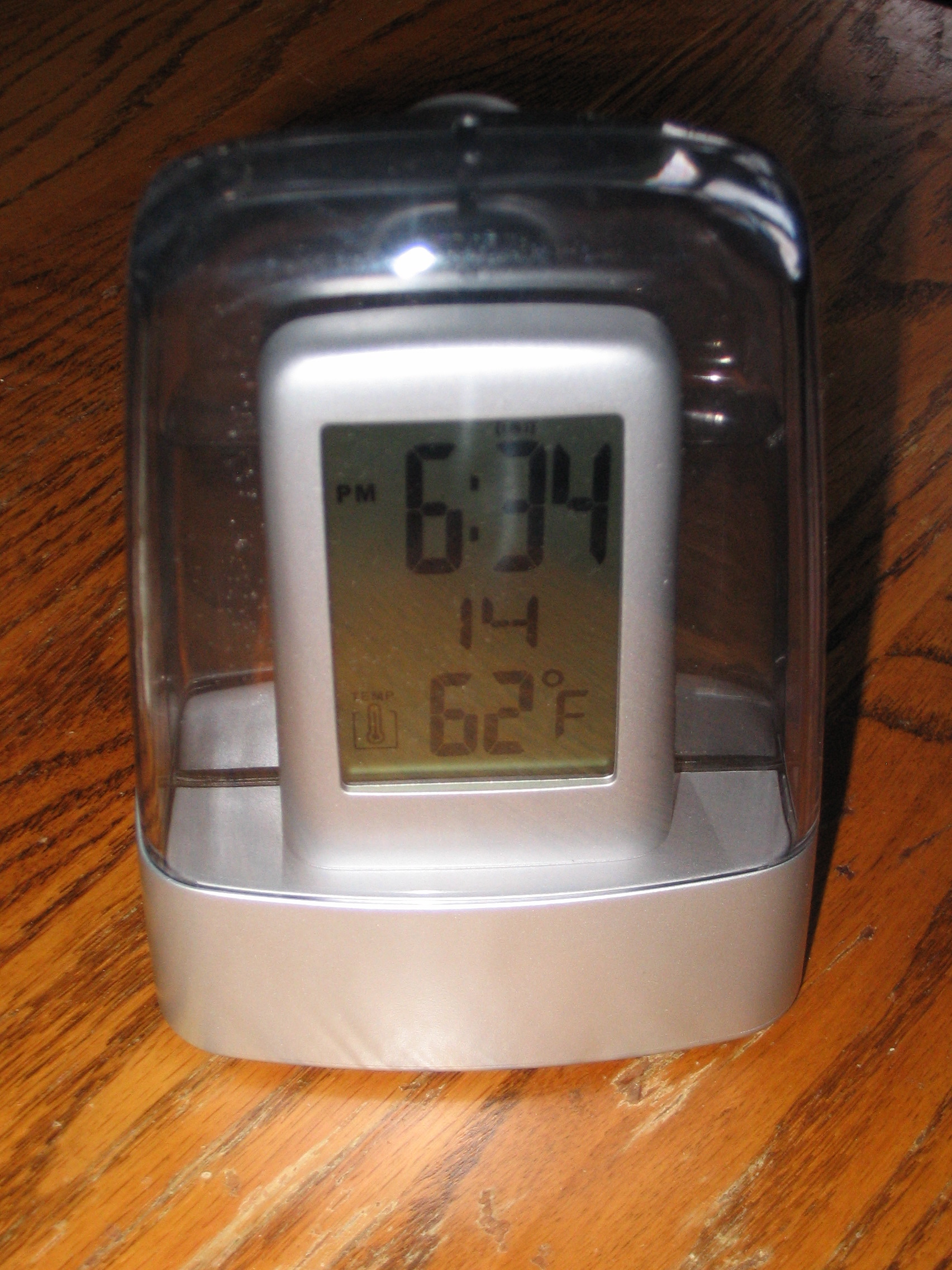
I need an alarm clock but I don't need to use electricity. Here is the water-powered alarm clock we got yesterday.
According to the Consumer Electronics Association, in 1975 the average household had fewer than two electronic products. In 2007, the average household had 25 consumer electronic products (computers, DVD players, video game consoles, cordless phones, digital cameras, high-def televisions).
It’s going to take a lot more than energy efficient lightbulbs to make a dent in runaway energy use. It’s going to mean taking a long, hard look at what we are using electricity to do. I’ve been going room to room, looking at what’s plugged in and asking myself:

carpet sweeper
In the past week, we’ve replaced 2 items that use electricity. The water-powered digital alarm clock pictured above tells you time, date, temp and has a decent, though not overly loud, alarm. You need to change the water once every two weeks to keep it running. It is not backlit – which can be both a blessing and a curse. We’ll see.
We also bought a carpet sweeper (again, from Lehmans) to reduce the use of the electric vacuum cleaner. This thing sure does a good job picking up cat hair. And I might develop some arm muscles using it… which wouldn’t be bad.
This is a really interesting interview with Naomi Kline and Amy Goodman about climate denial and identity. Finally, I get why some otherwise smart people are denying the reality of climate change.
“We’ve just ended the hottest decade on record. There’s overwhelming evidence that climate change is real now. It’s not just about reading the science. It’s about people’s daily experience. And yet, we’ve seen this remarkable drop, where (in a 2007 Harris poll) 71 percent of Americans believed climate change was real, and two years later, 51 percent of Americans believed it. So, a 20 percent drop. And we’ve seen a similar dramatic drop, just the floor falling out, in the same period in Australia and in the U.K.
“It’s not happening everywhere. It’s happening in countries that have very polarized political debates, where they have very strong culture wars.”
So 31 Republicans and 3 Democrats voted to repeal the EPA’s scientific endangerment finding on greenhouse pollution. This blog in Wonk Room shows who voted and quotes their past statements rejecting the “theory” of climate change.
Quite a number of them focused on the hacked emails of climate scientists that have been called “climate-gate,” as proof that climate science is fake. They fail, of course, to mention the number of scientific investigations into the matter. If you are interested in learning about the findings of these investigations undertaken by the scientific community, the Union of Concerned Scientists has a page that discusses it, with a number of links to reports.
A large number of electrical products draw power (phantom load) as long as they are plugged in. They have to be unplugged in order to draw no power — or plugged into a “smart strip” type powerstrip (like these smartstrips at Choose Renewables) that turns itself off when it senses the product is not in use .
Wondering about how much energy your various appliances and electronics use when on, off, or on standby? Here’s a useful website from Lawrence Berkeley National Laboratory. You may be surprised. Here are two tables:
The Union of Concerned Scientists has an informative presentation and quiz on the source of electricity in the East and Southeast of the U.S. Take the quiz – see how you do. Without giving away the answer, you’ll see a figure that fits with a previous post about why energy efficiency is not enough. Change is essential.
So where does Minnesota energy come from? Here’s a graphic from the MN Pollution Control Agency breaking down Minnesota energy sources. “Over half of the electricity generated in Minnesota comes from coal-fired electric power plants. Minnesota receives most of its coal supply by rail from Montana and Wyoming. Two nuclear plants near the Twin Cities typically account for nearly one-fourth of the state’s electricity production.”
So how much of our electricity can we replace with renewable energy here in Minnesota? Well, the Minnesota’s Renewable Energy Standard (RES) law requires that 25% of retail electricity sold in the state come from renewable sources by 2025 and we’re not close to that yet.
A few resources to bookmark when you want to learn more about energy, energy policy, and renewable energy resources:
GreenPeace has published a pocket guide that shows how “green” various paper products are. It’s nifty and foldable so it can fit in your wallet when you go to the store. I’m excited to see I can buy the 365 brand at Whole Foods.
Or… why we need to actually change what we do, not just how we do it.
Check out this story from Bjørn Lomborg, the author of The Skeptical Environmentalist and Cool It, head of the Copenhagen Consensus Center, and adjunct professor at Copenhagen Business School.
“Back in the early 1970’s, the average American expended roughly 70 million (BTUs) per year to heat, cool, and power his or her home. Since then, of course, we have made great strides in energy efficiency …. So how much energy do Americans use in their homes today? … roughly what it was 40 years ago: 70 million BTUs.
This surprising lack of change is the result of something economists call the “rebound effect” … the more efficient we get at using something, the more of it we are likely to use. Efficiency doesn’t reduce consumption; it increases it.
… Research findings along these lines, published in August in The Journal of Physics by energy economist Harry Saunders and four colleagues from the US Department of Energy’s Sandia National Laboratories… found that, “as lighting becomes more energy efficient, and thus cheaper, we use ever-more of it….”
The article ends with, “…we shouldn’t fool ourselves into thinking that swapping our current car for a Prius, or replacing our incandescent lights with energy-efficient fluorescent bulbs, will strike a meaningful blow against climate change.”
The author suggests it is more important to pressure government to give us better answers. I think the author can afford to say that because he doesn’t live in the U.S.
I think from a personal action standpoint, while we can try to influence legislators, we can also work on making more radical change, not simply going for the easy fix.
Phantom load is electrical use from appliances that are plugged in but not in use. According to the Union of Concerned Scientists, phantom load can account for 5-10% of the average home’s energy use, or some 65 billion kilowatt-hours of electricity each year. That adds up to 87 billion pounds of carbon dioxide in our air and $5.8 billion from our wallets. In other words, the energy vampires located all around our home are bleeding us dry.
 Think of It As An Adventure